When Mark Twain Tried to Tame a Bicycle
At 48, Mark Twain tried to master a high-wheel bicycle in Hartford. The attempt was real, but the crashes, commentary, and wounded dignity in “Taming the Bicycle” come through Twain’s carefully shaped comic voice. He makes himself—not his instructor or the children watching from the street—the centre of the joke. Beneath the humour is a useful lesson for preserving personal stories: a beginner’s struggle can reveal persistence, relationships, and character better than a polished success story. Record what looked easy before you tried it, the instruction your body resisted, the person who helped, the bystander who noticed, and the first small sign of progress. Keep the joke kind, identify remembered dialogue honestly, and let your present-day understanding join the scene.
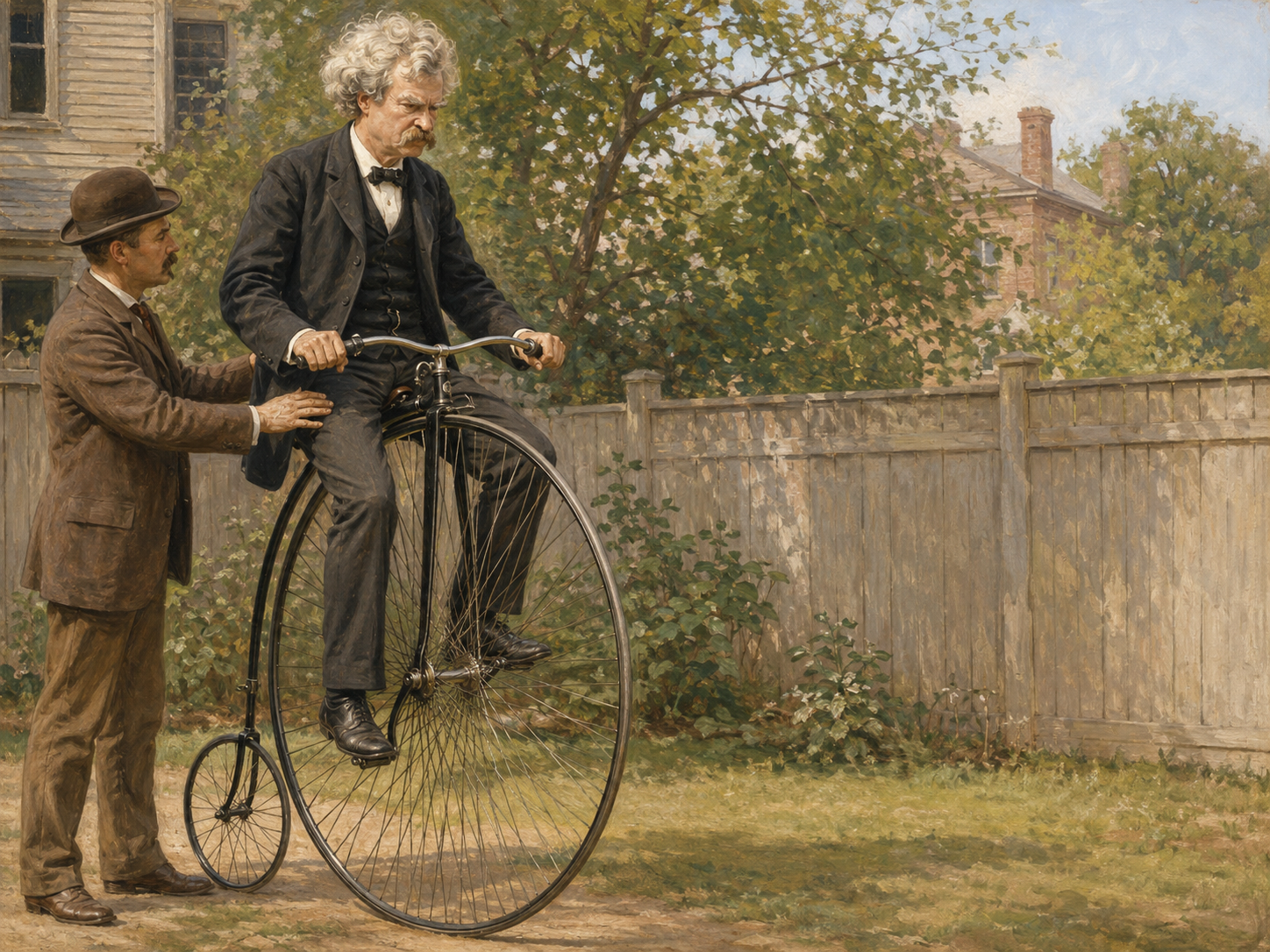
Mark Twain learned on a bicycle that looked more like a dare. Its enormous front wheel lifted the rider high above the ground; its small rear wheel trailed behind. Mounting, steering, and—most importantly—getting off gracefully required unfamiliar movements.
In May 1884, the 48-year-old Samuel Langhorne Clemens, better known as Mark Twain, decided to learn.
His effort became the comic personal essay “Taming the Bicycle.” The broad historical frame is well supported: Twain took high-wheel bicycle lessons in Hartford, Connecticut, with his friend Joseph Twichell. According to the Library of America’s account of the surviving evidence, their instructor worked for the nearby Columbia bicycle factory. Twain also spoke about the experience later that year at a gathering of cyclists.
The pratfalls, bruises, and dialogue in the essay come from Twain’s own highly polished comic telling. That distinction matters. This is a verified episode in his life, but the essay is humour, not an accident report. Twain stretches the scene for effect and makes himself the chief target of the joke.
That is precisely why the story remains useful to anyone preserving a life: it shows how an awkward attempt to learn something can become a warm self-portrait.
A machine that always won the landing
Twain begins with confidence and preparation. In his telling, he buys a bicycle and a comically large supply of a popular remedy for bumps and bruises. An instructor—called simply the Expert—comes home with him, and they choose the back yard for privacy.
The bicycle is a high-wheel model. Twain describes his as a “colt,” extending the joke by treating the machine like a skittish young horse. The Expert rides it first to demonstrate how easy the business should be. Then the pupil climbs up.
The first lesson does not proceed according to plan.
Twain repeatedly lands on the instructor, sometimes with the bicycle on top of both men. Each time, he directs attention to the machine: remarkably, it is unharmed. Human dignity, human comfort, and perhaps the Expert’s professional optimism all fare less well.
The Expert keeps changing position to avoid the next fall, while Twain somehow finds him again. Twain even credits the instructor with providing a softer landing than a feather bed.
It would be a mistake to treat every crash as a separately corroborated event. The essay turns physical mishap into choreography. Yet its comedy rests on a recognizable truth: a skilled person makes a difficult action look obvious, while the beginner discovers that every limb seems to have received the wrong instructions.
Knowing what to do is not the same as doing it
One of Twain’s sharpest observations concerns balance. When a novice starts falling to one side, instinct may urge a turn in the opposite direction. The bicycle demands the reverse: steer toward the fall to recover balance.
Twain turns that conflict into a small drama between intellect and body. Understanding the instruction does not make the body obey. The rider must replace an old reaction with a new one through repetition.
The essay says he took an hour-and-a-half lesson on each of eight days—12 hours altogether—before being judged roughly competent to ride without assistance. Even then, separate tasks had to be learned in sequence: balancing, steering, mounting, finding the pedals, and voluntarily dismounting. The involuntary dismount had already received abundant practice.
There is a generous idea beneath the jokes. Early clumsiness is not proof that someone is incapable. It may simply mean that the skill contains several smaller skills, each of which must become familiar. Twain’s narrator is vain, nervous, battered, observant, and still willing to return for the next lesson.
That combination makes him more appealing than effortless success would have done.
The first solo ride acquires an audience
After his lessons, Twain ventures onto a back street alone. He selects what seems to be a broad, peaceful road, although from the saddle it suddenly feels inadequate. A boy sits on a gatepost, eats maple sugar, and watches.
In Twain’s account, the boy becomes an unofficial commentator. He recommends pillows after one failed start and doubts that the rider could remain aboard even a horse-drawn streetcar. When Twain finally gets moving, he weaves across most of the available road at a solemn pace. A little girl giggles. The boy tells her to leave the rider alone because “he’s going to a funeral.”
The line works because Twain gives the observer the best joke. He does not write himself as the clever celebrity silencing an impudent child. He writes himself as the spectacle.
The road then reveals slopes that Twain had never noticed on foot. A tiny rise feels punishing; a slight descent feels alarming. Small stones become irresistible targets precisely because he tries to avoid them. A slow wagon seems to occupy nearly the entire world.
Again, the details are arranged by a comic writer. But they preserve something emotionally exact about being new at a physical skill: the ordinary environment changes. A calm street becomes a test course. A pebble becomes a decision. A bystander becomes an audience.
The story survived because Twain did not pretend to look capable
Twain worked on a bicycle sketch in 1884, but a surviving letter shows that he was unhappy with a version and said he had torn it up. A manuscript and part of a typescript nevertheless survived. Library of America dates the essay it publishes to around 1886; it first appeared after Twain’s death in the 1917 collection What Is Man? and Other Essays.
That publication history gives the piece an extra layer. Twain did not merely fall off a bicycle and immediately send the result to a newspaper. He revisited, shaped, and apparently abandoned the material. The funny story readers know is a crafted remembrance preserved among his papers.
The historical object also survived. A university exhibition catalogue featuring materials from major Twain collections identifies a 52-inch Columbia Expert bicycle from 1886 associated with him. The catalogue notes that he acquired this larger, more expensive model after the troubled learning experience and later passed it to an employee. It should not be confused automatically with every machine described in the essay, but it confirms that the bicycle was more than a passing fictional prop in Twain’s life.
How to preserve your own beginner story
Most families have a story about someone learning to drive, dance, skate, cook, use a computer, speak another language, or operate an unfamiliar tool. Too often, the preserved version shrinks to a verdict: “I was terrible at first” or “Grandad taught me.” Twain’s example suggests a richer approach.
Begin with the machine, place, or task. What looked easy before you tried it? Record the first small instruction your body refused to follow. Add the person who helped and the person who watched. Preserve one obstacle that seemed absurdly large at the time. Then show one sign of progress, even if it was only completing the task less badly than before.
Keep the joke kind. Twain can make the rider ridiculous because the rider is himself. When writing about someone else, invite their version and avoid turning a vulnerable moment into a performance they never agreed to give.
Also label the limits of memory. If you know you learned in 1972 but cannot remember which cousin made the famous remark, say so. If the punchline has been repeated for decades, identify it as family tradition rather than exact recorded dialogue. A story does not lose its charm when its source is clear.
Finally, let the older narrator appear. What do you understand now about the person who taught you? What did persistence feel like before you knew it would succeed? Did mastering the skill change where you could go, what work you could do, or how you saw yourself?
Twain closes with a compact recommendation: “Get a bicycle. You will not regret it, if you live.” The exaggeration is unmistakable, but so is the affection. The ordeal has become a story worth keeping.
If this brings back your own first lesson, you can begin a MemoryShare memory by writing or recording it. Save the awkward detail, the patient helper, the unhelpful audience, and the moment your body finally understood. Your story matters to us—even the part where the bicycle remained in better condition than you did.
Sources and further reading
Your story is worth preserving too.
Create and preserve your memories. Write them, record them by voice, and add photos when you are ready.
Preserve your memoriesReactions
Comments
No comments yet.