Before Julia Child Became a Chef, She Worked for a Wartime Intelligence Agency
Before Julia Child became a celebrated cooking teacher, she served in the Office of Strategic Services, the wartime predecessor of the CIA. Archival records show that Julia McWilliams worked in Washington, Ceylon, and China, handling sensitive communications and supporting emergency rescue research. Her section was connected with experiments on shark repellent, although she did not single-handedly invent it. The deeper surprise is how that chapter redirected her life: overseas service introduced her to new cuisines and to Paul Child, her future husband. The story offers a useful prompt for anyone preserving memories. An old job title often hides unexpected tasks, influential colleagues, meaningful objects, and turning points. Ask what happened before the chapter everyone knows—and save the answer while it can still be told.
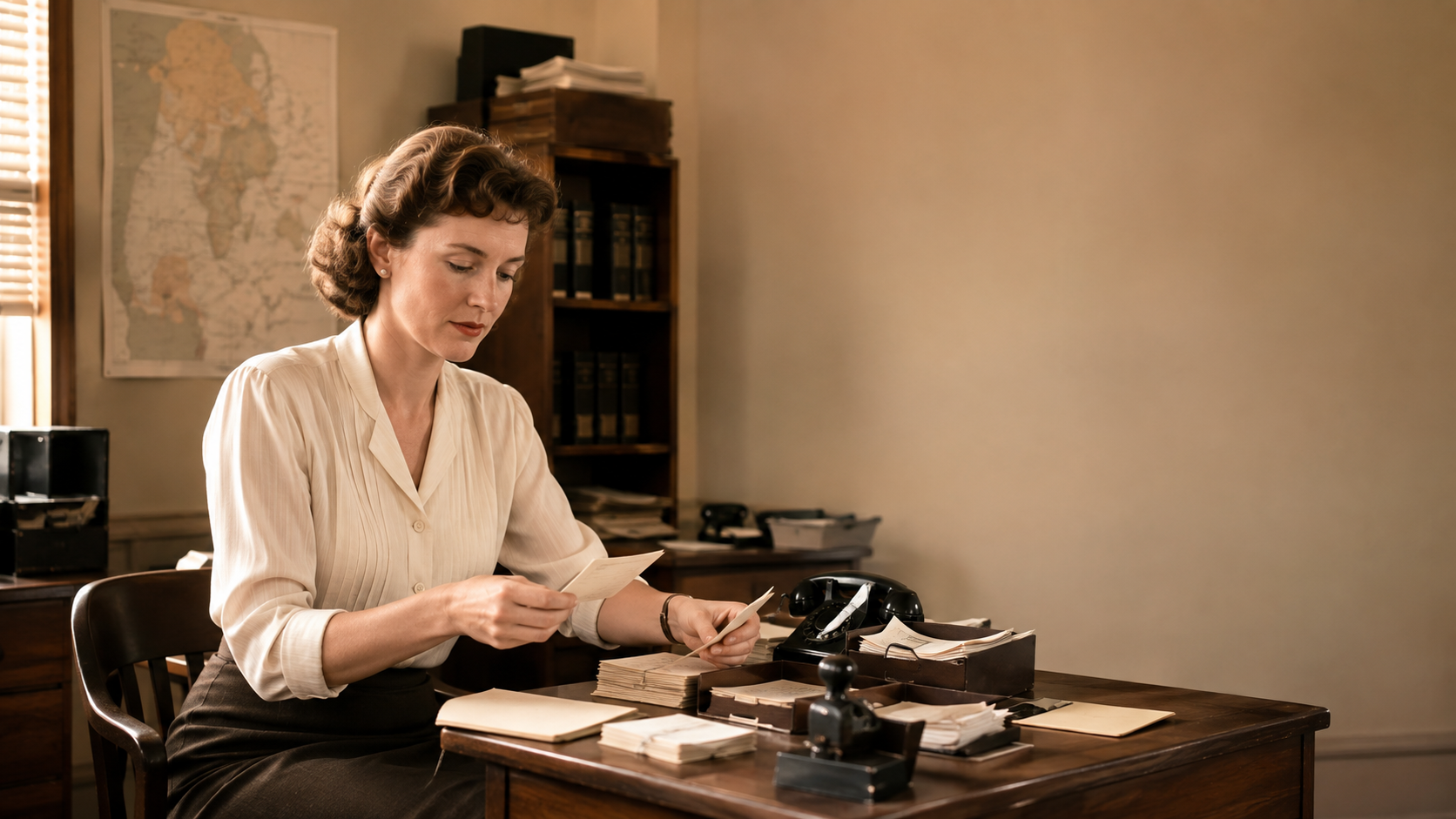
When people picture Julia Child, they usually see a tall, cheerful cooking teacher at a kitchen counter, calmly rescuing a recipe that has taken an awkward turn. That picture is true—but it is not the beginning of her working life.
Did you know that, years before she taught Americans to cook French food, Julia Child served with the Office of Strategic Services, the American wartime organization that preceded the CIA?
Her records place her far from a television studio. Known then by her maiden name, Julia McWilliams, she worked in Washington and later in Ceylon, now Sri Lanka, and Kunming, China. Her duties included handling sensitive communications and supporting research into emergency rescue equipment. That research included an especially memorable project: an attempt to develop a chemical shark repellent.
The real story is surprising enough without turning Child into a fictional master spy—or crediting her with single-handedly inventing shark repellent. The archival record shows something more interesting: a capable administrator and research assistant doing demanding work, travelling far from home, meeting the man she would marry, and encountering experiences that helped redirect her life.
An official record with a familiar name
The U.S. National Archives holds Julia McWilliams's OSS personnel file. Its guide to digitized OSS personnel records identifies her as a research assistant who later became a cookbook author and television personality. The Archives notes that hers is the only complete file among the selected OSS personnel files available there digitally.
Another National Archives page displays the oath of office she took on November 18, 1942. It is a wonderfully ordinary document for such an unexpected chapter: a government form bearing the name of a woman whose future fame would come from something entirely different.
Child began at OSS headquarters under director William J. Donovan. She was later assigned overseas. According to the Archives, the registry office where she worked received incoming and outgoing intelligence messages and helped determine which information was actionable. That is more precise—and more credible—than simply calling her a “spy.” Her contribution involved organization, judgment, discretion, and the careful movement of information.
Those skills may not sound dramatic. Yet anyone who has kept a complicated office, household, workshop, volunteer group, or family running knows how much depends on the person who can make sense of details.
The shark-repellent story, carefully told
The shark story is irresistible, which is exactly why it deserves careful wording.
During the Second World War, military leaders were concerned about service members stranded in tropical waters. The OSS coordinated work on emergency rescue equipment, including a search for a substance that might discourage sharks. The CIA's history of the project says that Child worked for zoologist Harold J. Coolidge for a year in 1943 as an executive assistant. She worked in close proximity to the officers developing the repellent and helped with the broader rescue-equipment effort.
Researchers tested more than 100 substances. Copper acetate became the principal ingredient in a dark, unpleasant-smelling cake designed to release its contents in water. Tests produced mixed reasons for hope and doubt. The same CIA account preserves the Navy's scepticism about whether results from bait tests would translate into protection when dangerous sharks were aggressively feeding.
So what may we safely say? Child participated in the OSS emergency-rescue section connected with the project. We should not say she personally invented the formula. The agency itself has explicitly cautioned against that simplified version of events. Even the claim that a related repellent was later used to protect returning space equipment is described by the CIA as difficult to confirm with documents.
That distinction does not make the story less delightful. It makes it human. Most useful work is collaborative. One person conducts tests, another manages correspondence, another evaluates results, and another makes sure information reaches the right desk. A good life story leaves room for the team.
A war assignment that changed a life
Child's overseas service mattered for reasons no personnel form could fully predict. The Smithsonian's National Museum of American History explains that she first encountered unfamiliar foreign cuisines while working for the OSS in Ceylon and China. She ate with colleagues, including Paul Cushing Child, whose enthusiasm for food began to influence her own.
Julia and Paul met while both were serving with the OSS. They married in 1946. When Paul's work took the couple to Paris in 1948, Julia's interest in food deepened. Paul encouraged her to study at Le Cordon Bleu, and her wartime service made her eligible for U.S. government-funded training. The Smithsonian's account of her developing passion for food even includes a small object she kept from the earlier chapter: a signalling mirror from around 1944, stored later in her kitchen junk drawer.
That mirror is a lovely bridge between two lives that were really one life. On one side stand secret communications, rescue equipment, wartime travel, and a demanding registry office. On the other stand Paris, culinary school, cookbooks, television cameras, and the Cambridge kitchen now preserved by the Smithsonian.
The connection is not a neat tale in which every early task obviously prepared her to cook. Lives seldom work that way. Instead, experiences accumulate. A posting leads to a friendship. A friendship becomes a marriage. Travel widens a person's tastes. An unfamiliar meal awakens curiosity. Years later, a small mirror in a drawer continues to hold the memory of who that person once was.
The question hidden inside an old job title
Famous lives often get compressed into a single label. Julia Child becomes “the French chef.” A relative may become “Grandpa the accountant,” “Aunt May the nurse,” or “Mum the teacher.” The label is not wrong; it is simply too small.
An old job title can open a much richer conversation. Instead of asking only, “Where did you work?”, try questions that recover scenes and relationships:
- What was one task people would never guess you had to do?
- Which colleague changed the direction of your life?
- Did you keep an object from that job, and why?
- What did you learn there that helped you much later?
- Was there a project your family has never heard about?
The most revealing answer may not concern an achievement. It may be about the lunch shared after a difficult morning, the person who knew how to fix the temperamental machine, the journey made for training, or the everyday object still sitting in a drawer.
Preserve the chapter before the famous chapter
Julia Child's OSS years remind us that a life does not begin when other people start paying attention. Long before public recognition, there are applications, ordinary assignments, uncertain plans, close colleagues, and unexpected turns. Those chapters explain how a person became who we remember.
You do not need an intelligence file in the National Archives to preserve such details. Start with one job, one object, or one journey. Record what happened, who was there, what surprised you, and what changed afterward. Memory Share can help you collect those scenes by voice or in writing and shape them into a story your family can keep.
What part of your working life would surprise the people who know you now? Your story matters to us.
Sources and further reading
Your story is worth preserving too.
Create and preserve your memories. Write them, record them by voice, and add photos when you are ready.
Preserve your memoriesReactions
Comments
No comments yet.