Before Group Chats, Friends Left Notes in Autograph Albums
Before social feeds and group chats, friendship and autograph albums let many people build one keepsake together. Archival examples preserve signatures, dates, poems, advice, drawings, and the occasional playful contribution from friends, classmates, relatives, visitors, and suitors. Their charm also reveals a problem: a surviving name may mean little once nobody remembers the relationship behind it. If your family has an old autograph book, yearbook, guest book, or signed programme, record who the contributors were and how they knew the owner. Or revive the custom at a gathering by inviting everyone to add one dated page—a saying, sketch, memory, or useful piece of advice—then preserve the story behind each contribution.
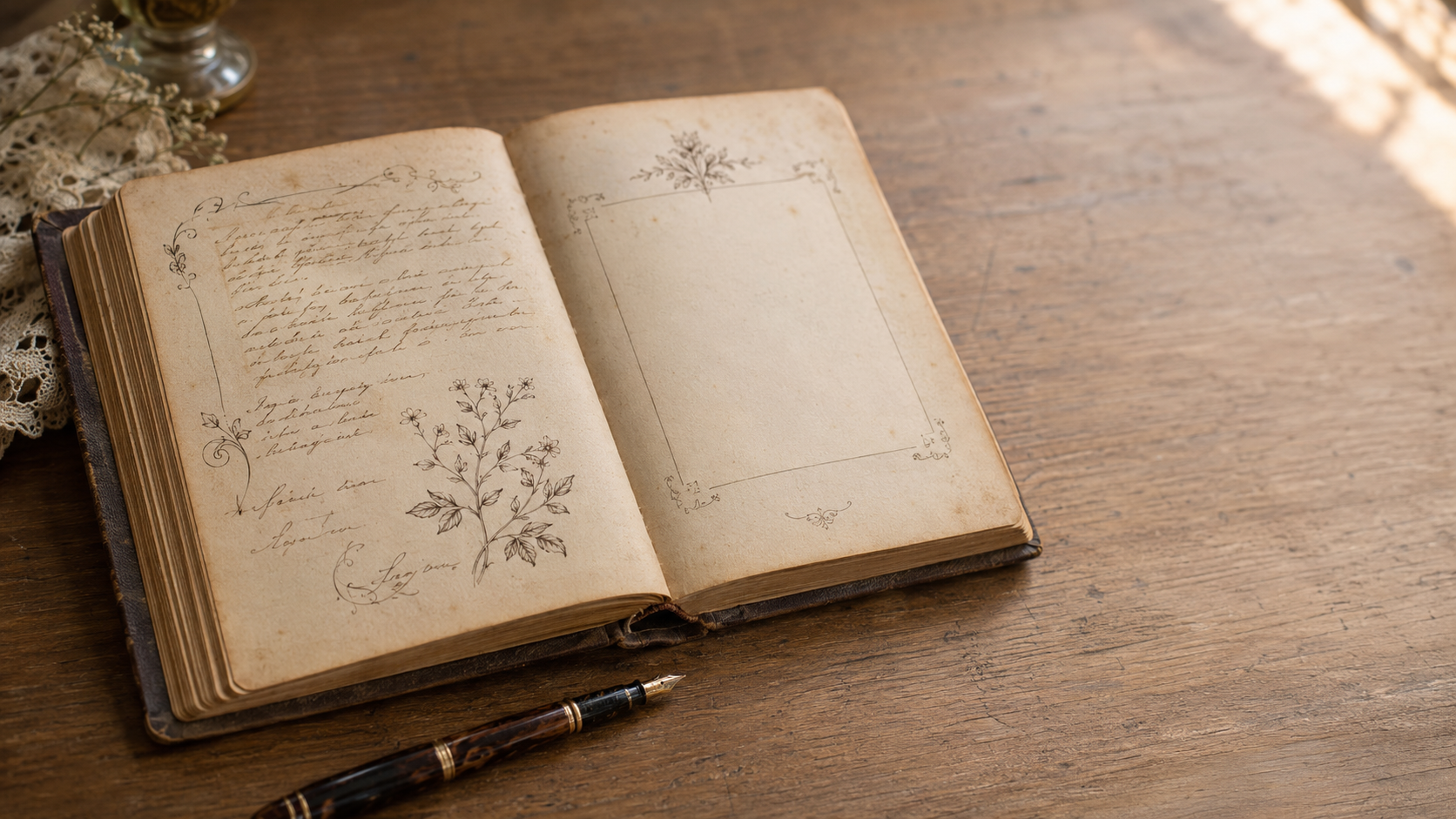
Imagine being handed a small, handsome book at the end of a visit. Its owner does not want your photograph or your contact details. Instead, you are expected to choose a clean page and leave something behind: your name, a date, perhaps a line of advice, a tiny drawing, or a joke good enough to survive the journey home.
That was the pleasure—and occasional pressure—of the friendship album. Long before a birthday greeting could be sent in seconds, people invited friends, classmates, relatives, visitors, and sometimes suitors to write directly into a book meant for keeping. The result was part guest book, part scrapbook, and part paper social network.
These albums were not private diaries in the usual sense. Their pages were collaborative. One person owned the volume, but many voices made it worth opening years later.
A portable circle of friends
An early form was known by the Latin name album amicorum, or album of friends. A digitized seventeenth-century example held by the Library of Congress belonged to Jacob Heyblocq of Amsterdam. The Library’s description explains that such books were popular among students who travelled between universities. A student could ask a person he met to add an inscription, commonly a short quotation or expression of friendship, along with a signature and date. Some contributors added a portrait or family coat of arms.
Heyblocq’s volume, compiled from 1645 to 1678, became unusually elaborate. Its pages include specially composed poems, aphorisms, Bible verses, and writing in several languages. It is a grand example, but the basic impulse is wonderfully familiar: “I met you; you mattered; please leave a trace.” The Library of Congress catalogue record for Heyblocq’s album allows readers to view the surviving pages.
The custom changed as it travelled. The Library of Congress’s American Folklife Center preserves twenty autograph albums and related items in the Duncan Emrich collection. Dating from 1843 to 1923, they represent German-American and Anglo-American traditions in several American states. The collection guide says the custom is thought to have begun among German students in the fifteenth century and reached the United States around 1820, where album writers adapted it.
By then, the circle had widened beyond travelling university men. Schoolboys and schoolgirls, college students, and women keeping “friendship books” all appear in the archival record. Some young women collected signatures and verses from suitors, as well as advice from relatives and visitors. Many continued adding entries after marriage. The album could follow a person from one stage of life into another.
Serious advice beside a cheerful doodle
The contents were gloriously mixed. According to the Duncan Emrich Autograph Album Collection guide, inscriptions could include signatures, poems, sayings, personal messages, quotations, calligraphy, and drawings. Serious counsel from an older relative might sit only a page away from a playful verse written by a school friend.
That unevenness is part of the charm. A formal message shows what someone believed was suitable for posterity. A joke or imperfect sketch may show more of the person. Even handwriting carries information: a confident flourish, a cramped attempt to fit one more thought into the margin, or a name written carefully by someone determined not to blot the page.
One surviving object at Smithsonian Gardens shows how decorative the practice could become. The “Golden Floral Album”, dated approximately 1883 to 1907, combines handwritten excerpts and verses with botanical illustrations. Its identified contributors included a friend and people writing from Chattanooga, Tennessee. The Smithsonian describes the addition of poems and flower tributes around page margins as a popular pursuit among middle-class Victorian women.
It is easy to picture the mild anxiety of facing such a page. Do you attempt wisdom? Copy a favourite poem? Draw a flower and hope it looks intentional? Write something funny, knowing the owner’s aunt may read it later? The album turned remembrance into a small performance—but one performed for a person you knew.
What an old signature cannot tell us alone
An inherited autograph album can look complete because every page is already filled. In truth, it often arrives with half its story missing.
The American Folklife Center notes that little background information accompanied many albums in its collection. Sometimes the original owner can be identified only by a first name. Dates in the entries help establish when a book was used, but donors did not always know its earlier history.
That is the quiet warning inside this light-hearted custom. A name preserves presence, but not necessarily relationship. “Mary, 1887” becomes far more meaningful if a family member can add that Mary was the owner’s cousin, nearest neighbour, or companion at school. A copied verse may seem generic until someone remembers that its writer recited poetry at every family gathering.
If your family owns an autograph book, school yearbook, guest book, or signed programme, ask about it while the connections can still be recovered. Who owned it first? How did the contributors know one another? Which person was the comedian? Did anyone remain a lifelong friend? Was one message quoted so often that it became a family saying?
Record the answers separately rather than squeezing new notes onto an old page. A simple list of names, relationships, places, and remembered details can restore the social circle around the object while leaving the original intact.
Try a friendship album for one afternoon
The custom is easy to revive without pretending it is still 1883. At a family lunch, reunion, birthday, or cottage weekend, put out a sturdy notebook and invite each person to contribute one page. Give people choices so no one feels required to produce instant poetry.
They might add:
- a saying they learned from an older relative;
- a small drawing of something associated with the day;
- a memory of how they met the book’s owner;
- a piece of advice they actually use;
- a place and date, plus one detail they hope everyone remembers.
Encourage contributors to sign and date their pages and explain unfamiliar names. A child’s invented spelling, an uncle’s terrible sketch, and a grandmother’s practical sentence all belong. Variety is not a flaw; it is the point.
You can then preserve the stories behind the pages in Memory Share. Record a short explanation in the contributor’s own voice or write down the context that the page cannot hold. The album keeps the mark of the hand; the accompanying memory keeps the person and relationship from becoming a mystery. Your story matters to us—and sometimes a whole story begins with nothing more than a signature and a date.
The oldest social feature still works
Calling a friendship album an early social network is an analogy, not a historical label. Still, the comparison reveals something useful. The technology was paper, yet the appeal was connection. People wanted proof of meetings, friendships, shared schools, travels, courtships, and family ties. They also wanted to see what others had written and decide what sort of impression they would leave.
Unlike a fast-moving digital feed, the album asked a person to pause over one page. That pause produced objects that archives can still study centuries later. The grand inscriptions survive, but so do ordinary names, familiar jokes, uneven drawings, and advice that may or may not have been followed.
If you could hand an album to one person from your past, whose message would you want inside it—and what story would you ask them to add beneath their name?
Sources and further reading
Your story is worth preserving too.
Create and preserve your memories. Write them, record them by voice, and add photos when you are ready.
Preserve your memoriesReactions
Comments
No comments yet.