Nellie Bly’s Best Detour: Meeting Jules Verne While Racing Around the World
In 1889, journalist Nellie Bly set out to circle the globe faster than the fictional Phileas Fogg. Soon after crossing the Atlantic, she accepted a risky detour to Amiens to meet Jules Verne, whose novel had inspired her journey. Their brief conversation included a playful comparison of her route with Fogg’s—and ended when Bly checked her watch and hurried for the only train that would keep her schedule intact. She completed the journey in 72 days, 6 hours, 11 minutes and 14 seconds. The lasting charm of her account lies not only in that record, but in the human details she preserved. Her example offers a memoir lesson: begin with the official fact, then record the worry, joke, practical problem and choice that reveal what the experience meant.
In November 1889, a young New York reporter began a journey that sounds invented: she would travel around the world faster than Phileas Fogg, the fictional gentleman in Jules Verne’s Around the World in Eighty Days. She had no aeroplane, no mobile telephone and no online timetable. She depended on steamships, trains and connections that might be separated by days.
Yet one of the most memorable parts of Nellie Bly’s journey was a delay she willingly accepted. Soon after reaching England, she went out of her way to Amiens, France, to meet Jules Verne himself.
The visit was brief, warm and slightly funny. It survives because Bly recorded the little particulars: a hurried invitation, an anxious look at her watch, a discussion of routes and a joke about why she would not follow Fogg’s path exactly. Those details turn a famous achievement into a human story.
A fictional challenge becomes a reporting assignment
Nellie Bly was the pen name of Elizabeth Cochran, a journalist for Joseph Pulitzer’s New York World. The Library of Congress describes her as a pioneer of investigative journalism and notes that she is especially remembered for her 1889–1890 trip around the globe.
In the account she published after returning, Nellie Bly’s Book: Around the World in Seventy-Two Days, Bly said the idea came while she was searching for a newspaper story. Why not try to make the journey imagined by Verne in real life? When she first proposed the assignment, an editor objected that a woman would need a protector and too much luggage. Bly answered that if the paper sent a man, she would go for another newspaper and beat him.
A year later, the paper summoned her. She was asked whether she could start within days. She could. The speed was part of the point from the beginning.
Bly left Hoboken on the steamship Augusta Victoria on November 14, 1889. PBS’s collection of excerpts from Bly’s own book gives her departure time as 9:40:30 in the morning. That precision is characteristic of her narrative: this was an adventure, but it was also a timed assignment.
An invitation that complicated the timetable
After the Atlantic crossing, Bly was met by the World’s London correspondent. He brought unexpected news: Jules Verne and his wife had sent a special invitation. Would Bly visit them in Amiens?
Her first response, as she later recalled it, was delight followed immediately by practicality. She wanted to meet Verne, but assumed that she had to refuse. The correspondent assured her that the side trip could fit the schedule.
So Bly went. Reaching Amiens required travelling through the night and changing the planned route. She was not treating Verne as a ceremonial stop arranged months in advance. This was an opportunity inserted into a journey in which a missed train could cost a week.
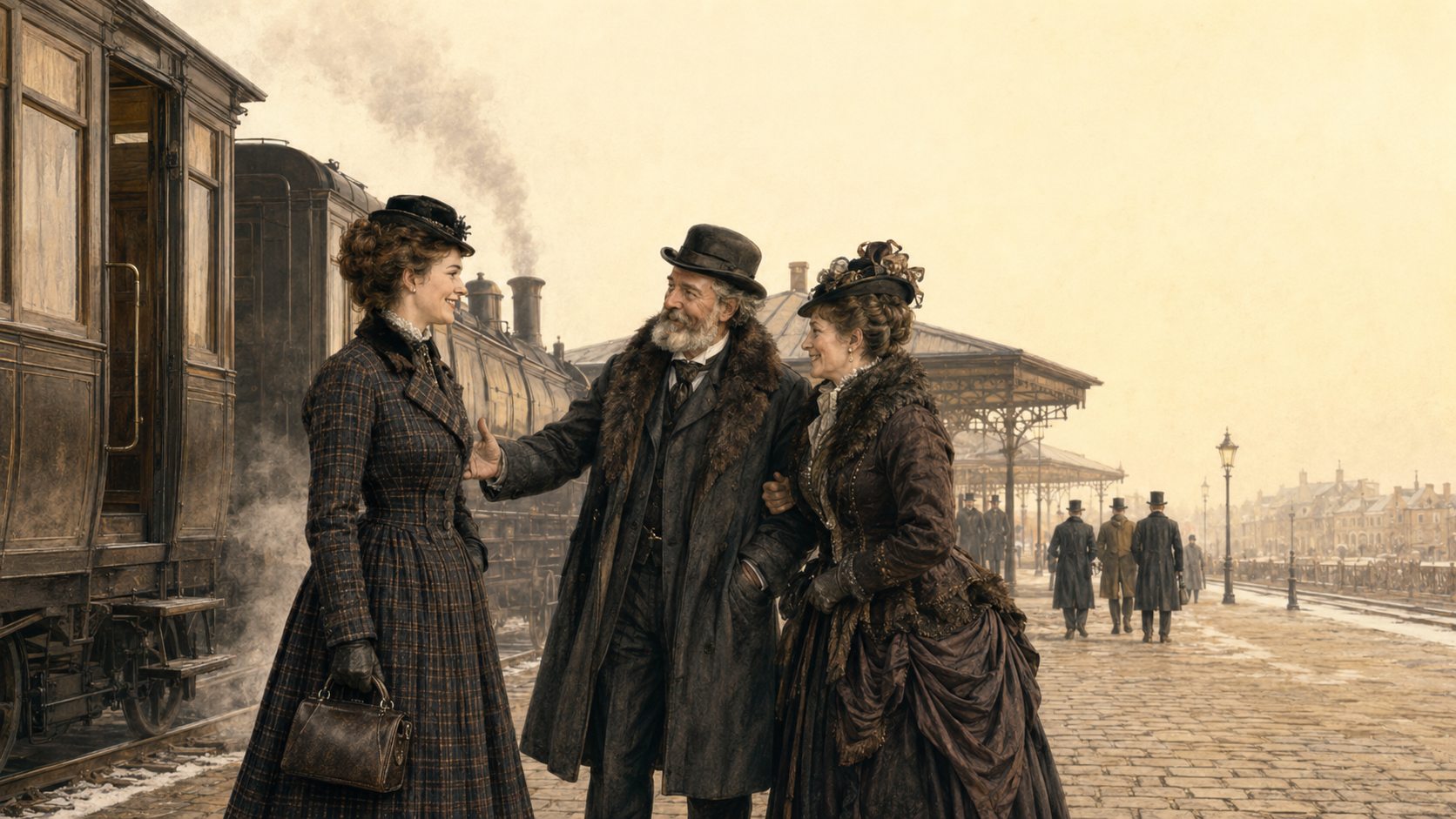
Her recollection of approaching the meeting is wonderfully ordinary. Seeing Verne and his wife waiting at the station, she worried that her face looked marked by travel and that her hair was untidy. The reporter who had accepted an enormous public challenge was, for a moment, simply a guest wondering how she appeared to her hosts.
That observation is useful to anyone recording a life story. A résumé would say, “Met Jules Verne in Amiens.” Bly tells us what the moment felt like.
The route, the widow and the watch
At Verne’s home, the travellers compared fiction with logistics. Bly recited her intended route: from New York to London, then through Calais, Brindisi, Port Said, Ismailia, Suez, Aden, Colombo, Penang, Singapore, Hong Kong, Yokohama and San Francisco before returning to New York.
Verne asked why she was not going to Bombay, as Phileas Fogg had. Bly replied that she was more interested in saving time than in saving a young widow—a playful reference to Fogg’s rescue of Aouda in the novel. Verne answered with a joke of his own, suggesting that Bly might save a young widower before she returned.
The exchange appears in Bly’s original 1890 book, digitized by the University of Pennsylvania, and in the PBS primary-source excerpts. It is a small scene, but it does several things at once. Bly shows that she knew Verne’s story, had designed her own route for real timetables, and could answer the celebrated novelist on equal terms.
Then she checked the watch on her wrist.
There was only one train she could take to continue towards Calais. Missing it, she wrote, would mean a week’s delay. The visit had to end. Bly later said that even if she had travelled around the world only for the pleasure of meeting Verne and his wife, she would not have considered the price too high.
That is the heart of the episode: the woman racing the clock decided that one conversation was worth making time for.
A journey measured in seconds—and remembered in scenes
Bly continued by rail and steamship, crossing Europe and travelling through the Suez Canal, Asia, the Pacific and the United States. Her trip ended on January 25, 1890. The Library of Congress records the elapsed time as 72 days, 6 hours, 11 minutes and 14 seconds. Police cleared a path through the cheering crowd when she arrived.
The public followed the journey so closely that the World ran a contest asking readers to guess Bly’s finishing time. The paper also printed a board game after her return. A surviving Library of Congress catalogue record describes its 73 spaces, one for each day of the journey, alongside images of Bly, Verne, a steamship and a train.
Those artefacts show the scale of the sensation. But Bly’s own narrative supplies something that a stopwatch and a game board cannot: seasickness at the rail of the ship, awkward competition for a railway foot-warmer, worry about travel-tossed hair, and a glance at a wristwatch in Verne’s home.
Her account also reminds modern readers to approach historical travel writing critically. Some of Bly’s descriptions of people and places use stereotypes and prejudiced language common in her era. They should not be repeated as neutral fact. Preserving a historical voice does not require endorsing every judgement in it.
The memoir lesson hidden inside the race
Most of us will never race around the world or meet the author who inspired our adventure. Still, Bly’s method offers a practical lesson for preserving any life.
Begin with the official fact, then ask for the scene around it.
If a relative says, “I met someone famous,” ask who was waiting at the station, what they worried about before saying hello, what made everyone laugh and what forced the visit to end. If the family story is “We nearly missed the train,” ask which train, what would have happened and who kept checking the time.
Four useful prompts are:
- What small detail do you remember before the important moment?
- What was said that made the occasion feel human?
- What practical problem was running in the background?
- Which part would never appear in an official record?
The answers may be the difference between a fact and a story. Dates establish that something happened; sensory details, dialogue and choices help another person understand what it meant.
Memory Share is built around that idea. A life need not be record-breaking to deserve a careful record. If the size of a full memoir feels intimidating, our guide to how creating memoirs can become easier offers a practical next step. The meaningful material is often in the pause beside the headline: a joke, a worry, a decision to take the detour. Your story matters to us.
What meeting or unexpected stop became the part of a journey your family still remembers?
Sources and further reading
- Nellie Bly’s Around the World in Seventy-Two Days, University of Pennsylvania Digital Library
- Primary-source excerpts from Bly’s book, PBS American Experience
- Nellie Bly Resource Guide, Library of Congress
- “Globe Trotting,” Library of Congress Today in History
- “Round the world with Nellie Bly—The World’s globe circler,” Library of Congress
Your story is worth preserving too.
Create and preserve your memories. Write them, record them by voice, and add photos when you are ready.
Preserve your memoriesReactions
Comments
No comments yet.