Build a Reading-Memory Journal, One Book at a Time
A remembered book can preserve far more than a plot. It may carry the room where you read, the person who lent it, the life question you were facing, and the ways your understanding later changed. This article adapts the old practice of keeping a commonplace book into a simple reading-memory journal. Choose one book with a life attached, then record how it reached you, who you were at the time, where you read, what stayed with you, what you see differently now, and which related memory should come next. Historical collections at Harvard, the British Library, and the Library of Congress show how readers’ selections and notes can reveal personal interests and habits of thought. The practical goal is modest: one book, one page, and one honest glimpse of the reader you once were.
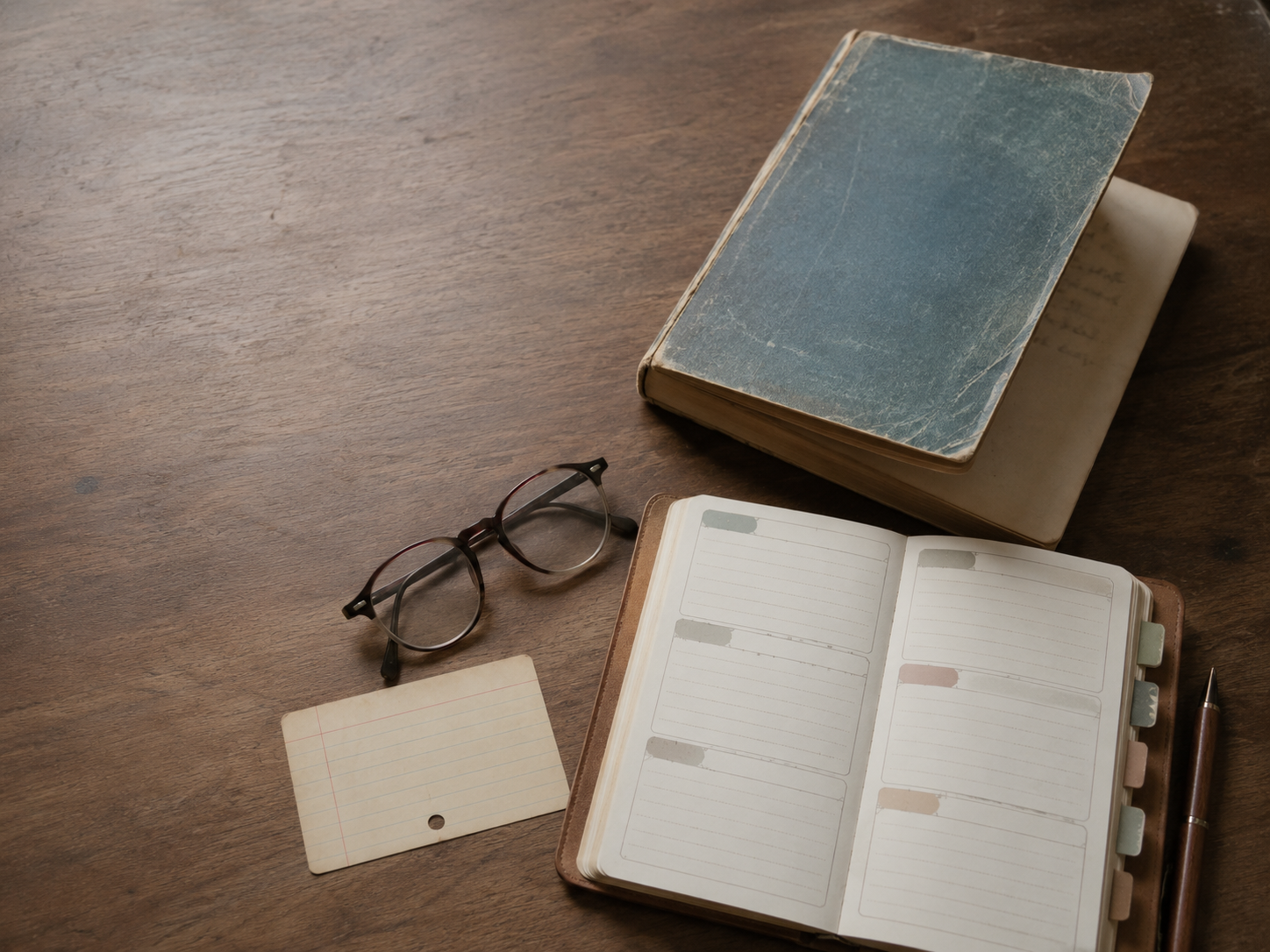
A book can mark a life as clearly as a birthday or a change of address. You may remember the mystery novel passed around a night shift, the cookbook with your father’s substitutions in the margin, or the paperback you read on a bus while deciding whether to accept a new job. Years later, the plot may be hazy while the chair, the weather, and the person who handed you the book remain surprisingly close.
That makes reading a useful doorway into reflective writing. The aim is not to review every book you have read or assemble an impressive list. It is to preserve the meeting between a book and a particular version of you.
One page is enough to begin.
An old practice with a personal possibility
Readers have long written while they read. A Harvard Library collection about the history of reading brings together annotated books, private library catalogues, lending records, and commonplace books. These materials do more than identify titles. Taken together, they leave evidence of what people selected, marked, organized, and returned to.
Commonplace books were not identical to modern diaries. Their keepers often copied passages and arranged material by subject. Yet the surviving volumes show how note-taking could become highly individual. Harvard’s Take Note exhibition explains that commonplace books could combine extracts from written or spoken sources with personal observation; their headings and arrangement reveal something about their compilers’ interests and habits of thought.
The examples are wonderfully varied. The British Library’s catalogue record for Richard Symonds’s seventeenth-century commonplace book describes sections on moral topics, plants, living creatures, and customs, alongside extracts from sources in several languages. The Library of Congress records that Thomas Jefferson began a literary commonplace book while still a schoolboy and continued it into the 1770s. Its exhibition page on Jefferson’s world of books identifies one entry as a passage from Laurence Sterne’s Tristram Shandy.
You do not need to imitate an early modern filing system—or Thomas Jefferson. The useful idea is simpler: what we choose from our reading can become a record of the reader. For a life story, however, add something many traditional commonplace entries do not supply: the circumstances around the book and your changing response to it.
Choose a book with a life attached
Do not begin by trying to name your “most important” book. That question can make the exercise feel like an examination. Instead, look for a book connected to a person, place, season, decision, routine, or surprise.
Try one of these doors:
- a book someone gave, lent, read aloud, or recommended;
- a title you carried through a journey, illness, move, or new job;
- a book you loved as a child and met again as an adult;
- instructions, recipes, poems, comics, or manuals used repeatedly at home;
- a book you disliked, abandoned, misunderstood, or argued about;
- a volume whose physical copy has its own story.
“Book” can be interpreted generously. A school reader, prayer book, repair manual, community cookbook, railway timetable, or stack of magazines may have shaped daily life more than an acclaimed novel did. The point is not literary prestige. The point is connection.
If you still own the copy, handle it carefully and look for evidence rather than treating every mark as a certain memory. An inscription can confirm who gave it and when. A receipt may locate a purchase. A stain or folded corner can prompt a question, but it does not prove how it happened. Write “I think” or “perhaps” when that is what you mean.
Make one six-part entry
Give the exercise 15 minutes. Put the title and author at the top if you know them, then write six short parts. A few sentences under each heading are enough.
1. How the book reached me
Who chose it? Was it borrowed, bought, assigned, inherited, or found? Record the exchange if you can: the kitchen where a friend pressed it into your hand, the library shelf you returned to, or the parcel in which it arrived.
2. The reader I was then
Add your approximate age, home, work, relationships, and preoccupations. Avoid summarizing an entire decade. Choose two or three facts that explain why this book met you at that moment.
3. Where reading happened
Reconstruct the practical setting. Were you reading in five-minute intervals, on a porch after dinner, or under a blanket after lights-out? What did the copy look and feel like? Which details do you clearly remember, and which need checking?
4. What stayed with me
Paraphrase the idea, character, image, instruction, or question that lingered. If you copy a short passage for private reference, also record the page number and edition so the words do not later float free of their source. In anything intended for public sharing, respect copyright and quote sparingly—or simply describe the passage in your own words.
5. What I understand differently now
This is the reflective centre. Perhaps the book once felt comforting and now seems complicated. Perhaps a character you ignored has become the one you understand. Perhaps the recipe was never really about food; it was how an aunt kept everyone at the table. A changed reading is not evidence that your younger self was foolish. It shows that a life continued.
6. What this book connects to next
Finish with one related memory you could write later: the person who lent the book, the trip on which you read it, the room where it lived, or the disagreement it started. A reading-memory journal can become an index to a much larger memoir.
Keep the book and the memory distinct
Reflective writing becomes more trustworthy when it separates three kinds of material.
First, there is what the published book says. Check the title, author, edition, and any wording you plan to reproduce. Second, there is physical evidence in your copy: inscriptions, annotations, tickets, and dates. Third, there is personal recollection: who was present, how you felt, and what the reading came to mean.
These layers can support one another, but they are not interchangeable. A publication date does not prove when you read the book. Handwriting may need to be identified rather than guessed. Two relatives may remember who owned the copy differently. Preserve those uncertainties in plain language. “My sister remembers buying it; I remember it already being in the house” is more interesting—and more honest—than false certainty.
Be equally careful with other people’s private notes. An inherited book may contain a letter, name, or comment its writer did not expect to be public. You can describe the object without sharing sensitive content. Reflection is selective, not compulsory disclosure.
Let the journal grow sideways
You can keep reading memories chronologically, alphabetically, or by themes such as “books people gave me,” “instructions I actually used,” and “stories I changed my mind about.” The structure can remain loose. Historical commonplace books were diverse, and your version does not need to satisfy a universal system.
After several entries, notice connections. A series of borrowed books may trace a friendship. Cookbooks may reveal who taught, adapted, or quietly ignored family rules. School texts may show what was taught—and what was absent. Re-read your entries for recurring people and turning points, not for the number of titles completed.
When one entry opens a larger story, expand it. Memory Share’s guide to creating memoirs explains how to save an individual memory as a chapter and later organize memories into a book. Your reading journal can supply small, specific beginnings: one volume, one version of you, one relationship worth remembering.
Choose a book whose title still carries a room, a voice, or a season with it. Write how it reached you, who you were, what stayed, and what changed. You are not building a list of books. You are recording a life in conversation with them.
Your story matters to us.
Sources and further reading
Your story is worth preserving too.
Create and preserve your memories. Write them, record them by voice, and add photos when you are ready.
Preserve your memoriesReactions
Comments
No comments yet.