The Day Agatha Christie Stood Up on a Surfboard
In 1922, long before Agatha Christie became fixed in the public imagination as a celebrated mystery writer, she learned to surf. Her letters, autobiography, and surviving photographs document early attempts in South Africa and days of practice at Waikiki. She remembered painful equipment, unsuitable conditions, misplaced confidence, and finally the moment she rode to shore standing up—a “complete triumph.” The evidence supports calling Christie one of the early recorded British women surfers, but not an unqualified claim that she was the world’s first Western woman to do it. Her story offers a practical lesson for preserving memories: record the awkward middle, the equipment, the warning, the helper, and the exact action that marked success. A precise, well-sourced learning story is more vivid than an unsupported superlative.
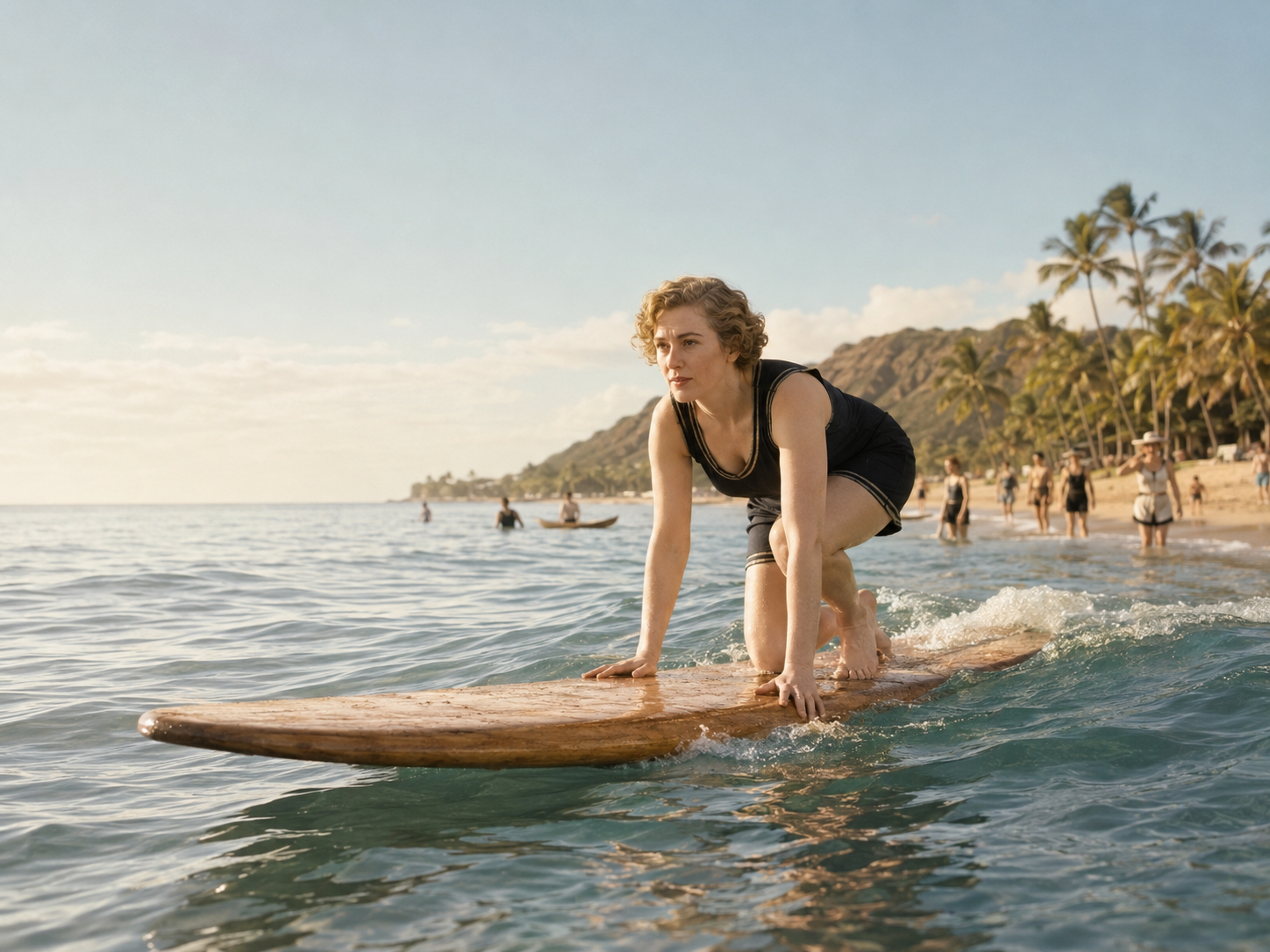
Picture Agatha Christie and a familiar image may appear: the composed creator of Hercule Poirot and Miss Marple, seated near a typewriter or surrounded by books. Now replace that picture with a very different one. Christie is 31, on a beach in 1922, learning to control a long wooden surfboard.
This is not a modern attempt to make a famous writer seem unexpectedly fashionable. Christie recorded the experience in letters to her mother and later in An Autobiography. Photographs survive too. The British Library has confirmed that its 2026 Christie exhibition includes images of her surfing in Hawaii in 1922, alongside a replica of the kind of board she used.
Her story is delightful because she did not arrive as an effortless expert. It is a story of enthusiasm, discomfort, misplaced confidence, repeated attempts and, finally, one upright ride to shore.
The journey behind the day at the beach
In January 1922, Christie left England with her first husband, Archie, on a ten-month journey connected with a trade mission promoting the forthcoming British Empire Exhibition. The itinerary took them through South Africa, Australia and New Zealand, then to Hawaii and Canada before they returned to England in December.
The historical setting deserves plain language. This was a British imperial trade mission, not simply a holiday assembled for two adventurous tourists. Christie travelled as part of that enterprise while also recording her own daily experiences. The surviving personal record is unusually rich. According to the official account of The Grand Tour, she wrote detailed letters home to her mother throughout the journey and took photographs with a portable camera. Those letters preserve motor trips, seasickness, sunburn and surfboarding—not just official destinations and scheduled events.
Surfing entered the story in South Africa. Christie and Archie travelled to Muizenberg when his work allowed it, hired boards and practised together. Her February letters pay attention to the equipment. She compared boards and noted that lighter models with curved ends were easier and less painful. That practical observation gives the memory texture. She did not merely write, “We tried surfing.” She remembered what the board felt like.
The couple’s South African experience also gave them confidence. Perhaps a little too much.
Confidence meets Waikiki
When the couple reached Honolulu, Christie later recalled, the sight of people surfing drew them quickly from their hotel to the beach. They hired boards and went into the water. Yet the conditions that day were not suitable for beginners. In her autobiography, she admitted that they were inexperienced, even though their earlier attempts in South Africa had encouraged them to think otherwise.
An observer warned them out of the water. They listened, but they did not abandon the project. They returned on later days and kept practising.
That sequence matters. A shorter retelling might jump straight from “Agatha Christie visited Hawaii” to “Agatha Christie could surf.” Her own account keeps the awkward middle: the warning, the difficult conditions and the gap between confidence and competence. The official Christie archive’s account of her surfing memories draws directly on her autobiography and letters. It records painful boards, fierce sunburn, physical strain and the clothing troubles that came with repeated days in the sea.
There was no instant transformation. The Museum of British Surfing’s timeline of Christie at Waikiki reports her recollection that, after ten days, she began trying to rise carefully from the board to her knees and then to her feet. Eventually she kept her balance and rode all the way to shore standing upright. In the autobiography, she called that moment a “complete triumph.”
Two words are enough. They carry the previous ten days inside them.
What we can safely claim
This story often appears with a bigger label: Christie was supposedly the first Western woman to surf standing up. That claim is tempting, but the evidence cited by authoritative sources does not justify presenting it as settled fact.
The official Christie site says she is thought to have been the first. Its page for The Grand Tour uses a more cautious formulation, saying research suggests she may have been among the first Britons to learn to surf standing up. The Museum of British Surfing calls her one of Britain’s first women surfers. Those are meaningful distinctions.
What is firmly supported is already interesting. Christie surfed in South Africa and Hawaii in 1922. Her letters and autobiography describe the attempts. Photographs from the Christie Archive Trust show her surfing in Hawaii. She learned to stand on the board and remembered the successful ride as a moment of triumph. We do not need to award her an unprovable world record to enjoy the scene.
This is a useful rule for any true life story: keep the wonderful part, remove the unsupported superlative.
The famous name and the learning self
Christie began writing her autobiography decades after the surfing trip. The official history of the book says she started it in 1950, completed it in 1965 and arranged for it to appear only after her death. By then, the young beginner on the surfboard belonged to a much earlier chapter of her life.
That distance may be one reason the episode feels so generous. The established writer did not need to turn her younger self into a prodigy. She could preserve the beginner: eager, overconfident, warned away from unsuitable waves, sore from the effort and delighted when practice finally worked.
Fame tends to flatten a life into its most recognizable achievement. A novelist becomes her books. A musician becomes the performances. Within families, the same thing happens on a smaller scale: someone becomes “the teacher,” “the quiet aunt” or “the one who was always good at everything.” Stories of learning restore movement to that still picture.
They also let us meet a person before the outcome was certain.
How to preserve your own “complete triumph”
You do not need a journey to Waikiki or a place in literary history to tell a story with this shape. Think of something you once learned badly before you learned it well: driving a manual car, skating, baking bread, speaking a new language, using a power tool, dancing or sending your first email.
Then record the middle, not only the result:
- What made you want to try?
- What equipment or clothing do you remember?
- What did you misunderstand at first?
- Who warned, taught or encouraged you?
- What was physically awkward, tiring or funny?
- How many attempts came before the first small success?
- What exact action told you, “I can do this now”?
Be cautious with the polished family version. If everyone says an uncle was “the first in town” to do something, ask what record supports that claim. Perhaps he was the first in his workplace, the first among his friends or simply the first person the family remembers doing it. A precise truth is not a smaller story. It is a story readers can trust.
Also notice the detail that proves the memory belongs to a lived day. Christie preserved the feel and shape of the boards, the unsuitable waves, the warning and the progression from lying down to kneeling to standing. In your story, the anchoring detail might be a stiff pair of skates, the smell of a stalled car, a recipe card spotted with butter or the person waiting patiently beside you.
A life is larger than its best-known chapter
Agatha Christie’s surfing memory does more than add an unexpected hobby to a famous name. It shows a person in the middle of learning—before success could be compressed into a neat sentence.
That is worth preserving in any life story. Write down the attempt that went badly, the practical detail nobody else would know, the person who told you to try again and the modest victory that felt enormous at the time. Memory Share can help you keep that scene in your own words, by writing or by voice, so the learner is remembered alongside the expert.
What was your own “complete triumph”—the first moment you realized that practice had finally worked? Your story matters to us.
Sources and further reading
Your story is worth preserving too.
Create and preserve your memories. Write them, record them by voice, and add photos when you are ready.
Preserve your memoriesReactions
Comments
No comments yet.