Lord Byron’s Tame Bear and the Story a Letter Saved
In 1807, Lord Byron wrote to Elizabeth Pigot that he had acquired a tame bear while a student at Trinity College, Cambridge. When people asked what he planned to do with it, he joked that the bear should sit for a fellowship. Trinity College preserves the letter’s wording and context, while later institutional accounts wisely leave some details of the bear’s daily life uncertain. That makes the episode a useful memory lesson as well as a funny historical story: keep the date, source, setting, and voice, but label later embellishments as tradition or interpretation. Family archives work the same way. A small note, letter, or recollection can preserve personality more vividly than an official record. What unusual visitor, family rule, or perfectly timed joke deserves to be saved in your own story?
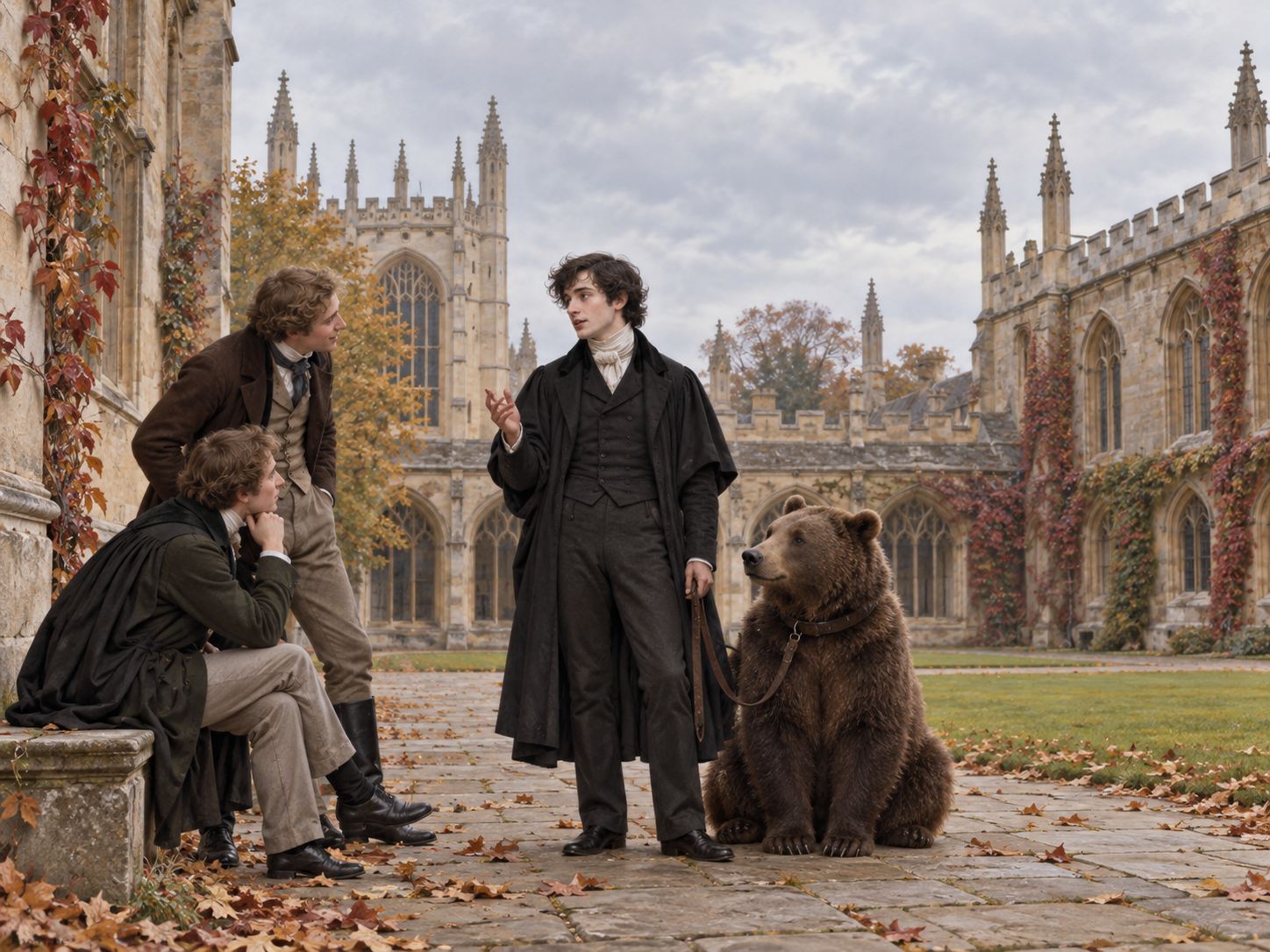
It is easy to imagine a famous poet surrounded by grand subjects: mountains, politics, romance, exile, and the kind of serious portrait that makes a person look as if they were born already posing. Then a letter interrupts the picture.
On 26 October 1807, while he was a student at Trinity College, Cambridge, George Gordon, Lord Byron wrote to his friend Elizabeth Pigot about a new companion. It was not a fellow poet, a political ally, or a fashionable guest. It was a tame bear.
Byron’s own letter, preserved in Trinity College’s account of its literary history, says that when people asked what he intended to do with the bear, he replied that “he should sit for a fellowship.” The joke depended on a college rule and on Byron’s appetite for theatrical answers. It also left us something better than a polished legend: a small, dated glimpse of a young person being funny in a particular place, among particular people.
That is the appeal of the story. The bear is memorable, but the letter is the real treasure.
A bear enters the record
The basic evidence is unusually clear. Trinity College identifies the source as Byron’s letter to Elizabeth Pigot, dated 26 October 1807, and quotes his description of the animal as “a tame Bear.” The college also places Byron at Trinity from 1805 to 1807 in its historical overview. A later Trinity account, published for a programme of readings of Byron’s work, repeats the same letter and describes the bear as part of the poet’s student life.
That does not mean every colourful detail repeated online deserves equal confidence. The safest version is the one the letter supports: Byron had a tame bear, people asked what he meant to do with it, and he answered with the fellowship joke. The letter does not tell us where the animal slept, who fed it, or how long it remained with him.
This is a useful distinction for anyone preserving family history. A story becomes stronger when its edges are visible. “Grandfather kept a goose in the kitchen for a week” is one kind of record if Grandfather wrote it down at the time. It is another if a cousin remembered hearing it sixty years later. Both may be valuable. They simply need different labels.
Byron’s bear has a near-contemporary written source, and that source still has a personality in it. He is enjoying the absurdity and expecting his friend to understand the joke.
Why a fellowship?
The line makes more sense when we pause over the setting. A fellowship at Trinity was an academic position, not a pet-care arrangement. Byron was pretending that the bear might qualify for one of the college’s serious offices. The humour comes from putting a large, non-human visitor into the dignified language of academic advancement.
The answer also reveals something about the social world around him. Byron told Pigot that the response to his joke did not delight the people who heard it. He then described an evening gathering that included jockeys, gamblers, boxers, authors, parsons, and poets. Even in a short letter about a strange pet, he was sketching a cast of characters and presenting himself as the host of an unusually mixed company.
That surrounding detail matters. If we reduce the episode to “Lord Byron owned a bear,” we get an amusing fact. If we keep the date, recipient, location, joke, and social setting, we get a tiny life scene. We can picture a young man writing to someone who knew him well, pleased with his own answer and eager to report the reaction.
The story is interesting because a document lets us hear how he wanted a particular moment understood.
The rule behind the joke—and the limits of the evidence
Trinity’s modern account says Byron was notorious for bringing a bear to college because dogs were not allowed. The University of Cambridge has also presented the episode as part of its history of animals connected with Cambridge, while noting that the bear’s exact arrangements are less certain than the popular image suggests.
That qualification is worth keeping. A memorable anecdote attracts additions. Later retellings may turn a written quip into a fully staged scene: the bear strolling through college, dining in a room, or occupying a specific stable. Some of those details may have supporting evidence; others may be guesses built around the original letter. Unless a source establishes them, they should not be presented as facts.
There is no loss in saying “the evidence shows” and “the later tradition suggests.” In fact, that language makes the surviving evidence more vivid. We know Byron’s letter exists. We know what he said about the bear. We know the college remembers the incident. We do not need to invent a complete bear biography to enjoy the moment.
This approach is especially helpful with family stories. Memory often improves a story’s rhythm. A remembered punchline may become sharper, a journey shorter, a kitchen larger, or a childhood mishap more perfectly timed than it really was. The task of preserving a family story is not to drain away its humour. It is to keep the humour beside an honest note about where the detail came from.
For a practical way to place a vivid scene inside a larger, fact-conscious life record, see MemoryShare’s guide to building a memoir around turning points. A timeline can hold the date and setting; the scene can hold the voice.
What the letter preserves that a résumé cannot
Most accounts of a famous person are built from achievements. Byron’s poems, travels, political commitments, relationships, and public reputation all help explain why he remains historically significant. But a résumé cannot show the texture of an ordinary day—or the kind of joke someone made to a friend.
The bear letter preserves several small things at once:
- a practical fact: Byron had a tame bear;
- a social fact: other people questioned the arrangement;
- a verbal habit: he answered with an elaborate joke;
- a relationship: he expected Elizabeth Pigot to follow the reference;
- a mood: he was entertained by the whole scene;
- a setting: the letter belongs to his Trinity years and describes a gathering around him.
None of these details alone explains a life. Together, they make it less flat.
The same principle applies to a family archive. A photograph of someone receiving a certificate tells us an achievement. A note on the back saying “the elevator broke, Aunt May arrived in slippers, and we celebrated with pie” may tell us more about how the day felt. A formal record gives us the occasion. A personal note gives us the people moving through it.
When you preserve a story, ask what would disappear if you kept only the official version. Would you lose the nickname, workaround, badly timed joke, or object nobody expected to matter? Those details are often how history becomes personal.
A small Sunday prompt for your own archive
Choose one family story involving an unusual rule, an unexpected guest, or an answer that made everyone laugh. Then write five lines:
- What is the earliest source you can identify—a letter, diary, photograph, newspaper, or person’s recollection?
- What exactly does that source establish?
- Which part is remembered or repeated later?
- What detail reveals the storyteller’s personality?
- What remains uncertain?
You do not need a famous poet or a bear. Perhaps someone brought a pet to a workplace, used a wedding cake as breakfast, hid a bicycle in a hallway, or answered a serious question with a family phrase. The point is to save the moment in its own proportions.
If you record it by voice, begin with the source: “I remember this because…” or “According to the letter…” That opening makes room for both affection and accuracy. Future readers will know what they are hearing, and they may be able to add another piece.
MemoryShare is made for those small pieces: the stories that might never appear in an official biography but would be missed if they vanished. Your story matters to us—not because every memory must be extraordinary, but because an ordinary life is full of details only one family can preserve.
So here is the Sunday question: what family rule, odd visitor, or perfectly timed joke deserves to be saved before the people who understand it best are no longer here to explain it?
Sources and further reading
- Trinity College Cambridge, “Trinity in Literature” — includes the 26 October 1807 letter from Byron to Elizabeth Pigot.
- Trinity College Cambridge, “The Byrothon: a 24-hour reading of alumnus Lord Byron’s works” — provides the college’s contextual account and repeats the letter’s wording.
- University of Cambridge, “Lord Byron and the bears beneath Cambridge” — places the bear story in Cambridge’s documented animal history and notes the limits of the popular account.
Reactions
Comments
No comments yet.