Your Life Is Not a List: Build a Memoir Around Turning Points
A life timeline is useful, but it is not yet a memoir. This practical guide offers a two-pass method for turning chronology into a story with direction. First, make a simple factual timeline using names, dates, places, relationships, and broad life periods. Then identify moments after which something changed: a belief, decision, relationship, or sense of home. Choose three to five connected turning points, give each one a scene card, and test different arrangements before drafting. The article also explains how to handle remembered dialogue, uncertain dates, and conflicting family accounts honestly. Instead of trying to write an entire life from birth onward, begin with one vivid doorway into the larger story—and let the timeline remain the helpful scaffolding behind it.
When people decide to write a memoir, they often begin with a perfectly reasonable sentence: “I was born in…” Then come school, work, marriage, moves, children, holidays, and perhaps the year the basement flooded. Before long, the draft resembles a very long form at a government office—accurate, worthy, and not especially eager to be read.
A chronology is useful. It helps you remember what happened and when. But chronology is the scaffolding, not necessarily the finished house. A memoir becomes more engaging when the writer chooses moments that changed something: a belief, a relationship, a direction, or an understanding of the past.
The practical solution is a two-pass outline. First, build a factual life timeline. Second, find the turning points hidden inside it and use those moments to shape the story.
Why make the timeline first?
A timeline takes pressure off the blank page. You are not yet trying to sound literary or decide what your whole life “means.” You are simply making a working record.
This approach has strong support in writing and oral-history guidance. UCLA Extension’s memoir-planning course emphasizes timelines and outlines as tools for identifying stories and organizing them coherently. The Smithsonian Institution Archives advises oral-history interviewers to develop a chronology of important life events, along with lists of significant people and places. Although that guidance is written for interviewers, the same preparation is useful when you are interviewing yourself on the page.
Start with what you know. The U.S. National Archives’ genealogy guidance recommends beginning with yourself and paying attention to four practical categories: names, dates, places, and relationships. Those categories make an excellent skeleton for a memoir timeline too.
Draw a line down a sheet of paper, open a simple document, or make a table. Add broad periods rather than every year:
- childhood home
- school years
- first jobs
- partnerships and friendships
- parenthood or caregiving
- moves and migrations
- losses, recoveries, and fresh starts
- communities, interests, and work that mattered
Beside each period, note names, places, approximate dates, and any records that might help. A question mark is allowed. “Probably 1978” is more honest and useful than a confident guess.
Pass one: build a timeline without writing the book
Set a modest limit—perhaps 30 minutes—and write short entries only. “Moved to Winnipeg; first apartment; knew nobody” is enough. You are collecting signposts, not composing chapters.
Use these questions to fill gaps:
- Where did I live, and who lived with or near me?
- What work did I do, including unpaid work and caregiving?
- Which arrivals or departures changed daily life?
- When did a friendship begin, deepen, or end?
- Which decisions altered the next five years?
- What ordinary routines belonged to each period?
- Which dates can I check in letters, certificates, calendars, or public records?
If a relative can help, ask permission before recording a conversation and explain how you may use it. The Smithsonian’s oral-history guidance recommends open-ended prompts, close listening, and respect for the narrator’s choices. For a timeline gap, “What do you remember about our move to the new house?” is usually more productive than “That was in 1984, wasn’t it?”
Do not worry if the timeline looks uneven. Ten entries for one summer and none for three quiet years may simply show where your story has energy.
Pass two: circle moments when something changed
Now read the timeline with a different question: not “What happened next?” but “What was different after this?”
A turning point need not be dramatic enough for a newspaper. It might be the afternoon you finally understood why your father never took holidays, the first shift at a job you expected to hate, or a conversation that made you reconsider an old family rule. The change can be external, internal, or both.
Circle five to ten candidates. For each one, finish these sentences:
- Before this, I believed or expected…
- Then something happened…
- I responded by…
- Afterward, I saw, chose, or understood…
- I understand it differently now because…
The last sentence matters. Memoir is not only a report from the younger you; it also makes room for the perspective of the person writing today.
Next, choose three to five turning points that seem to belong together. They may share a subject—work, belonging, parenthood, migration—or a recurring question, such as “What did home mean to me?” You do not need to include every important event. Selection is part of writing.
Give each turning point a scene card
Create one card or short note for every chosen moment. Include:
- Place: Where does the scene happen?
- People: Who is present, and what does each person want?
- Action: What changes during this particular moment?
- Concrete detail: What could someone in the room notice?
- Reflection: What can you understand now that you could not then?
- Uncertainty: Which details need checking or careful wording?
The Dallas Baptist University Writing Center’s memoir guide notes that memoirs can be organized chronologically, begin in the middle or near the end, or use flashbacks. It also highlights setting, character, dialogue, imagery, and specific information as useful narrative tools.
Treat remembered dialogue carefully. Unless you recorded the exchange or have a written source, you probably cannot promise every word is exact. You can summarize the conversation, signal that you are recalling its substance, or use only the brief words you genuinely remember. Accuracy builds trust; invented polish does not.
Choose an order that serves the meaning
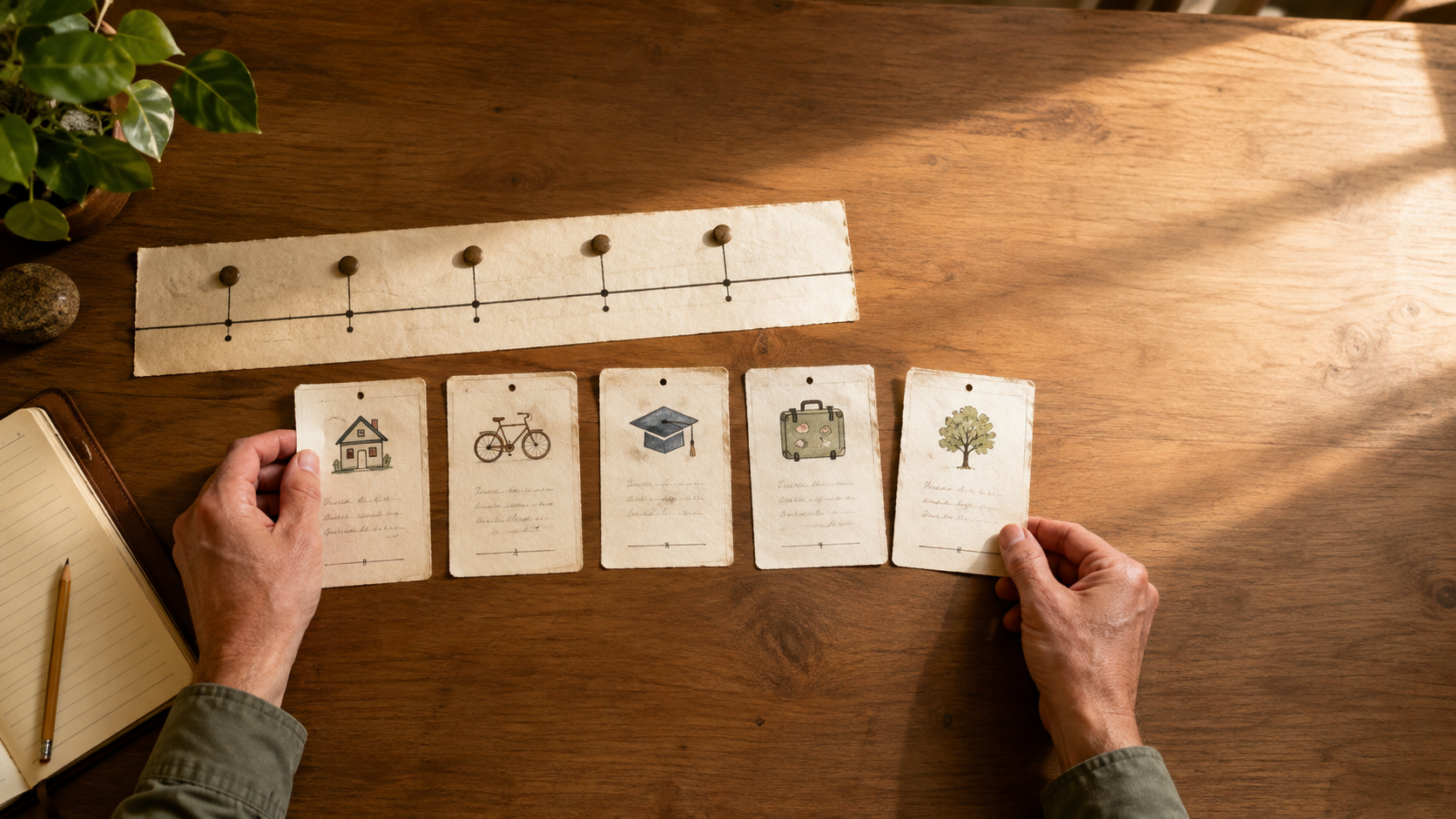
Lay the scene cards on a table. First arrange them by date. Then try a second order.
Could you open with the moment of greatest change and return to its beginning? Could two scenes from different decades illuminate each other? Would a straight chronology make the transformation clearest?
Smith College’s memoir-writing advice suggests using a timeline to focus and recall details, while also considering a turning point as an opening and a structure that is not tidily chronological. That is not a command to scramble time. It is permission to test which arrangement best serves your story.
Read only the card titles aloud. The sequence should suggest movement: “I wanted this; this disrupted it; I tried that; I learned or changed.” If the order feels like a pile of unrelated anecdotes, return to your central question and remove a card. A smaller, connected memoir is stronger than a complete catalogue with no clear path.
Draft one doorway, not the whole house
Choose the turning point that has the clearest place, action, and change. Write only that scene. Begin where something is already happening: a suitcase on the bed, a supervisor calling your name, a child asking an impossible question.
Try these prompts:
- What did I want as I entered this moment?
- What was the first sign that events would not go as expected?
- What did I notice but misunderstand at the time?
- What choice did I make next?
- What does this moment reveal about the larger question of my memoir?
After drafting, add a short reflection from your present viewpoint. Keep it proportionate. Let the scene carry the experience and the reflection clarify why you chose to preserve it.
Keep facts and memories in honest company
Your timeline can also become a checking list. Mark details as confirmed, approximate, remembered differently by others, or still unknown. Look for records when exactness matters, especially for names, dates, places, and relationships. If accounts conflict, you do not have to crown a winner. “My brother remembers that winter differently” can be both accurate and revealing.
The aim is not to turn a family memoir into a legal deposition. It is to distinguish what you know, what you remember, and what you infer.
Once your first scene is drafted, save it where you can organize it with later pieces. Memory Share can help you record or write individual stories and arrange them over time. Start with one turning point, then another. Your story matters to us—and it does not need to begin at the beginning.
Sources and further reading
Your story is worth preserving too.
Create and preserve your memories. Write them, record them by voice, and add photos when you are ready.
Preserve your memoriesReactions
Comments
No comments yet.