Did You Know Jane Austen Wrote a Very Biased History of England at Fifteen?
At fifteen, Jane Austen wrote a thirty-four-page *History of England* that openly called itself partial and prejudiced. The satirical manuscript defended Mary, Queen of Scots, attacked Elizabeth I, and made fun of the idea that history could always be perfectly impartial. Her sister Cassandra painted portraits of the monarchs, and Austen copied the work into a notebook given by her father. The volume survived through Austen family members before entering the British Library’s collection. This small, playful book preserves more than an early literary experiment: it records sisters collaborating, family jokes, a young writer testing her voice, and a private audience that understood the references. For family historians, the lesson is simple: save imperfect early writing, identify the people behind its jokes, and preserve the context that makes it meaningful.
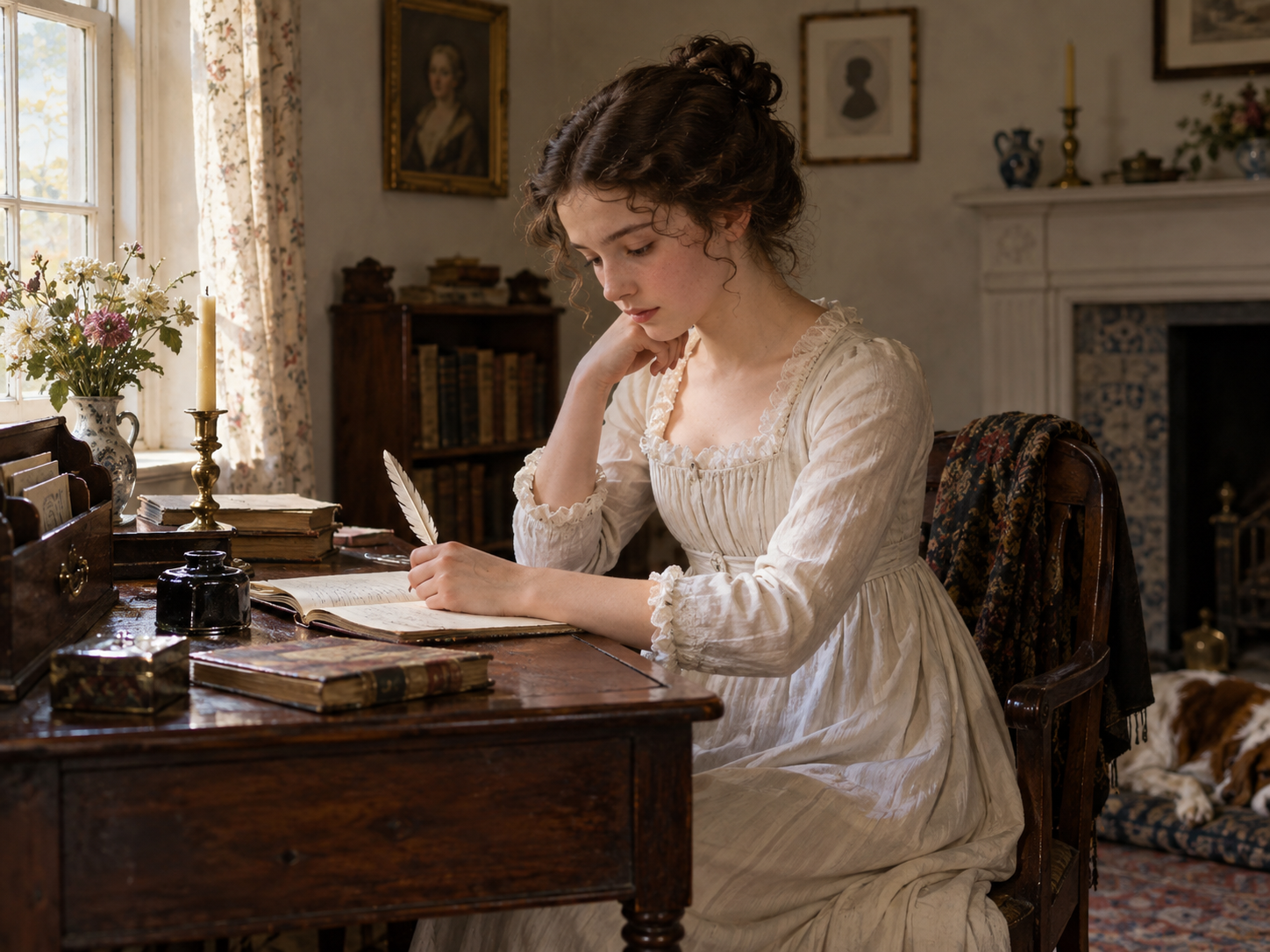
Jane Austen is usually introduced through polished novels, memorable proposals, and quietly devastating observations about family life. But one of the most revealing surviving pieces of her writing was created long before Pride and Prejudice. At fifteen, Austen wrote a short, comic, openly partisan History of England for the amusement of people who knew her well.
It was not a school essay trying to sound respectable. It was a family manuscript: handwritten, illustrated by her sister Cassandra, preserved in a notebook, and full of opinions that the young author did not bother to disguise. The little book shows a famous writer before fame had narrowed the way later generations imagined her. It also offers a useful reminder for anyone preserving family stories: early, informal, imperfect work can carry an unusually strong voice.
A history book with a warning label
The work is usually called The History of England from the Reign of Henry the 4th to the Death of Charles the 1st. Jane Austen wrote it in November 1791, when she was three weeks short of her sixteenth birthday. The surviving manuscript runs to thirty-four pages and covers thirteen monarchs.
The title page tells readers not to expect a neutral textbook. Austen describes herself as a “partial, prejudiced, & ignorant Historian” and warns that there will be few dates. In the same spirit, the book’s declared purpose is not to provide a complete survey. It is a comic argument shaped by the author’s own loyalties.
That is the first surprising fact. Jane Austen did not begin her writing life by trying to sound impartial. She began by making fun of the claim that history could always present itself as perfectly objective. The University of Oxford’s St John’s College describes the work as a satire of both historical writing and the conventions of the eighteenth-century history book.
Her judgments are wonderfully uneven. Mary, Queen of Scots receives an enthusiastic defence. Elizabeth I, by contrast, is treated with extraordinary severity. Austen’s account is less interested in balancing every side than in making its preference unmistakable. She is not hiding the point of view; the point of view is the joke.
Cassandra helped make the book
The manuscript is also a record of collaboration between sisters. Cassandra Austen supplied small painted portraits of the monarchs, including Mary, Queen of Scots and Elizabeth I. The images are not an optional decoration added by a later publisher. They are part of the object’s original family-made character.
Jane copied the text into a notebook that her father had given her. She titled the notebook Volume the Second. The British Library identifies it as one of only three surviving volumes containing Austen’s early writing, known collectively as her juvenilia. The Library’s manuscript catalogue records that the volume also contains other early compositions, including Love and Friendship, Lesley Castle, a collection of letters, and pieces dedicated to family and childhood friends.
That history of ownership matters. After Jane’s death, the volume passed to Cassandra, then through their brother Francis and later descendants before the British Library acquired it in 1977. A surviving manuscript is never only evidence of the person who wrote it. It can also preserve who kept it, who valued it, and which family decisions allowed it to reach the present.
A private joke hiding in a public history
The work was written for a small circle, and some of its humour depends on family knowledge. Austen mentions Sir Francis Drake’s circumnavigation of the globe, then adds a teasing prediction about a young sailor who already seems likely to fulfil the expectations of his relations and friends. That young sailor was almost certainly her brother Francis, who had recently transferred between naval ships.
The Oxford account makes the important point that Austen’s juvenilia was written first and foremost to entertain its immediate readers. The joke was not aimed at an abstract public. It was aimed at people who knew the family, the young sailor, and the circumstances behind the allusion.
This is one reason the manuscript feels so alive. It contains a version of Jane Austen that is not merely “the future novelist.” It contains a sister teasing a brother, a younger writer trying on a form, and an author expecting her first readers to understand the people behind the references.
Family writing often works this way. A sentence that looks cryptic to an outsider may be perfectly clear to the people who shared the kitchen, the schoolroom, the workplace, or the holiday. A nickname, an unfinished anecdote, or a comic exaggeration can be valuable evidence of relationships even when it needs explanation.
The value of an unfinished voice
It would be easy to treat Austen’s teenage history as a charming prelude to the novels that came later. That would be accurate, but too narrow. The manuscript also shows experimentation: a young writer testing satire, choosing a narrator, building a structure, and deciding how much truth a “history” must contain.
The early work is not polished in the same way as her mature fiction. That is precisely why it is useful. It shows development rather than presenting talent as something that appeared fully formed. The archive preserves the work before revision, reputation, and publication changed the conditions around it.
Many family records have the same value. A school composition, a handwritten recipe, a letter full of crossings-out, or a child’s illustrated story may not look important when it is made. Years later, it can reveal vocabulary, humour, friendships, ambitions, and the private audience a person imagined. Its rough edges are not defects to remove. They are part of the evidence.
If you are collecting a family story, do not wait for a perfect memoir. Save the early version. Keep the funny wording. Record who was in the room when the story was told. Note which details are certain, which come from someone’s later recollection, and which remain family tradition. A short piece made for three relatives may tell future generations more about a household than a formal biography ever could.
For a practical way to organize the larger pattern of a life, see how to build a memoir around turning points. The small pieces—the joke, the object, the remembered audience—often help reveal which moments deserve a larger place.
What Jane Austen’s teenage book invites us to ask
The most useful question is not simply, “What did this person become?” It is, “What were they already playing with, noticing, and arguing about before anyone called them important?”
Ask a parent or grandparent:
- What did you write, draw, collect, or perform when you were young?
- Who was the first person who took your work seriously?
- Which family joke would make no sense without its original context?
- Did a brother, sister, friend, or teacher help you make something?
- What early opinion did you later change—and what stayed the same?
The answers may lead to a notebook in a drawer, a school prize, a recipe card, or a story someone has repeated for decades. Preserve the object and the explanation together. The paper shows what survived; the conversation can tell you why it mattered.
Jane Austen’s little history is memorable because it contains both a person and her people. Her voice is sharp, funny, and unmistakably partial. Cassandra’s painted portraits, their father’s notebook, the family references, and the manuscript’s long journey through Austen descendants all remain in the frame.
That is what a preserved life story can do at its best. It does not flatten a person into a famous label. It keeps the relationships, experiments, opinions, and unfinished edges that made the person recognizable in the first place. Your story matters to us.
Sources and further reading
Reactions
Comments
No comments yet.