Did You Know George Washington Ran a Major Whiskey Distillery?
George Washington’s retirement included a surprising business chapter: a commercial whiskey distillery at Mount Vernon. His letters show that farm manager James Anderson proposed the venture in 1797 and that Washington approved a small trial before expanding it. By 1799, estate records listed sales totalling 10,942 gallons. The full story, however, extends beyond the famous owner. Anderson supplied crucial expertise, while enslaved distillers Hanson, Peter, Nat, Daniel, James, and Timothy performed hot and exhausting work. A surviving ledger, contemporary correspondence, archaeology, and reconstruction help separate evidence from legend. The practical takeaway for family historians is to look beyond familiar job titles. Letters, receipts, ledgers, tools, and other ordinary records may reveal a late-life experiment—and the overlooked people who made it possible.
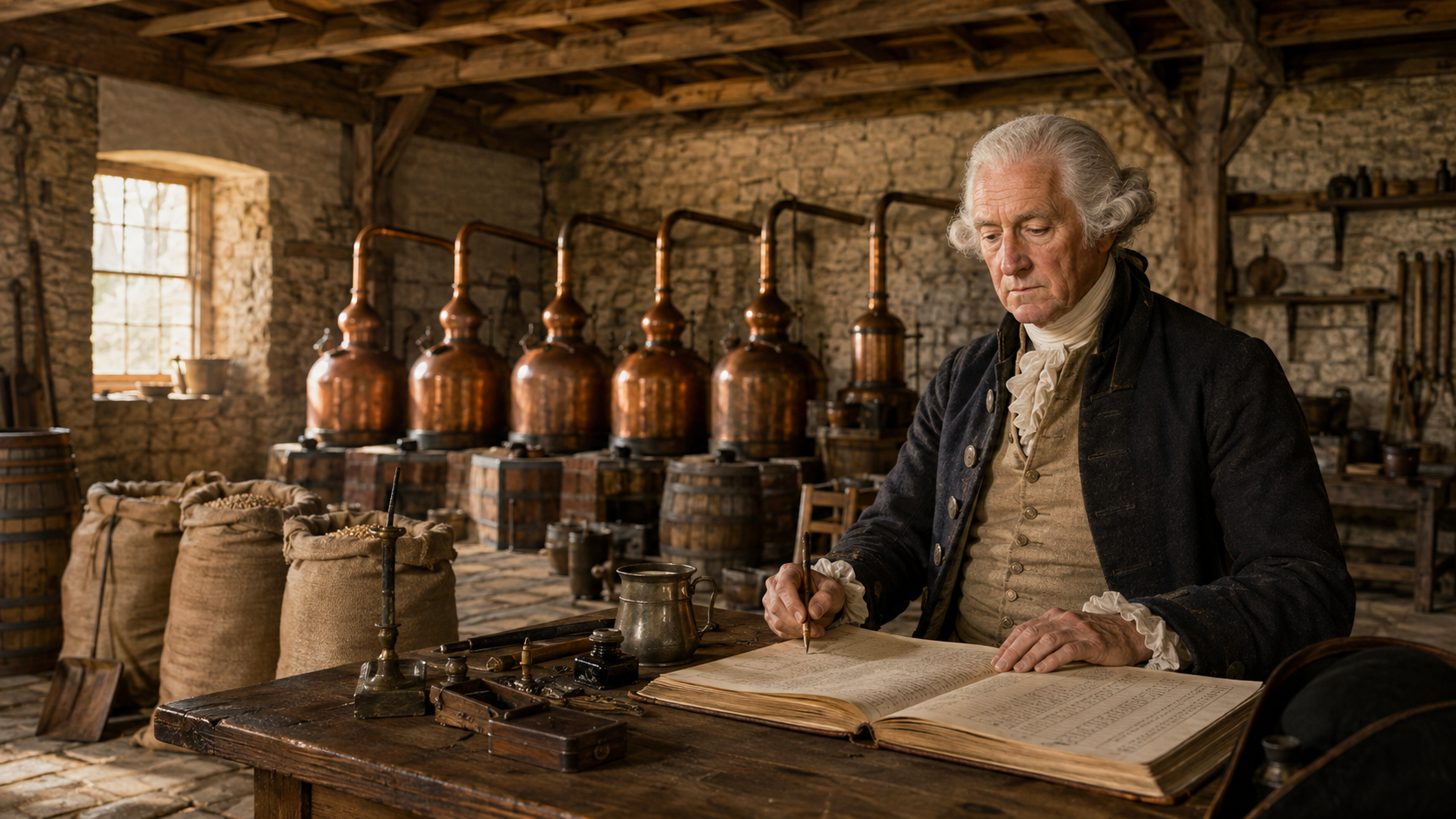
The familiar picture of George Washington’s later life is quiet and ceremonial: the former president back at Mount Vernon, receiving visitors and surveying his farms. The surviving paperwork adds a less familiar scene. In his final years, Washington approved, expanded, and monitored a commercial whiskey distillery that became one of the largest operations of its kind in the United States.
This is not a tavern tale polished by repetition. Washington’s own correspondence, a surviving business ledger, archaeological research, and Mount Vernon’s records document the venture in unusual detail. They also show why the story should not be reduced to the novelty of “the president who made whiskey.” The enterprise began with another man’s expertise, depended on the exhausting labour of enslaved men, and left a paper trail that lets us see both business decisions and people too often pushed to the margins of the story.
The proposal came from a farm manager
James Anderson, a Scottish-born farmer and experienced distiller, became Washington’s farm manager at Mount Vernon in 1797. Anderson proposed turning rye, corn, and other grain into whiskey rather than selling everything in its raw form.
Washington was still president when he answered from Philadelphia on January 8, 1797. His reply is wonderfully direct: “I consent to your commencing a distillery.” He approved the purchase of a still and allowed part of the cooper’s shop near the mill to be used for the experiment. His letter also reveals a practical worry. The mill brought many visitors to the site, and Washington feared that people using legitimate business as a pretext might visit or rob the still.
Two weeks later, after considering the operation’s need for running water, Washington approved the mill location on a temporary basis. The result, he wrote, would determine whether a larger and more permanent establishment should follow. In modern language, it was a trial before expansion.
The trial worked. Anderson reported in February that his son and “one boy” were managing two stills and expected to produce at least 80 gallons that week. He also described feeding the spent grain to livestock—one way the distillery fitted into the wider farm economy rather than standing alone.
A small test became a large operation
By the autumn of 1797, construction had begun on a purpose-built stone distillery near the gristmill. The enlarged operation used five copper pot stills. Mount Vernon’s historical account records production of about 4,500 gallons in 1798. In 1799, the year Washington died, its records list sales totalling 10,942 gallons, valued at $7,674.
Those figures are more informative than a rounded claim that Washington made “a lot” of whiskey. They show how quickly an experimental sideline became a substantial commercial enterprise. The surviving ledger identifies more than 80 transactions in 1799 and records customers ranging from nearby farmers and merchants to family members and Mount Vernon overseers. Whiskey could also be exchanged for services or for grain that would return to the production cycle.
The ledger itself is a remarkable survival. Mount Vernon’s digital catalogue describes roughly 50 folio pages covering the distillery and the estate’s Potomac River fishery during Washington’s final years and just after his death. Entries were written by Tobias Lear, Washington’s private secretary, and James Anderson. Washington endorsed the book twice. On a 1799 account, his signed review certified that the entries had been examined and properly supported.
This is the sort of historical object that corrects our mental picture of a life. A portrait can tell us how a person wished to be seen. An account book tells us what demanded attention on an ordinary working day: grain, cash, taxes, repairs, sales, and the names of people doing business.
The work behind Washington’s name
The famous owner is only part of the history. Anderson supplied the distilling knowledge and managed the project. More importantly, the physical production depended on enslaved workers.
Mount Vernon identifies six enslaved distillers by name: Hanson, Peter, Nat, Daniel, James, and Timothy. They performed the hot, tiring work of producing whiskey from rye, corn, and malted barley and probably slept above the distillery during its busiest periods. Enslaved coopers and carpenters also supported the estate’s business operations by making barrels, maintaining equipment, and constructing or repairing buildings.
That fact cannot be treated as a footnote to an amusing piece of presidential trivia. Washington owned the enterprise and received its returns; enslaved people did essential work without freedom or wages. The records let us name some of them, but the evidence is still uneven. We know far more about the owner’s decisions and accounts than about the workers’ thoughts, relationships, and daily experiences.
A responsible “Did you know?” should make the surprise more accurate, not merely more entertaining. Yes, George Washington entered the whiskey business late in life. But he did not invent or operate it by himself, and its success cannot be understood without James Anderson’s expertise and enslaved labour.
What survives—and what was reconstructed
The distillery building visitors see today is not the eighteenth-century original. The National Park Service explains that the original gristmill and distillery buildings fell into disrepair and were torn down in the 1800s. Today’s functioning structures are reconstructions informed by documentary and archaeological research.
That distinction matters. A reconstructed place can help visitors understand scale, sound, heat, and movement, but it should not be mistaken for an untouched original. The ledger and letters supply contemporary evidence; archaeology adds material evidence; the reconstruction interprets both.
Together, these sources make the historical claim unusually strong. They establish when Washington approved the project, how cautiously it began, how quickly it expanded, what it sold, who managed it, and who performed much of its hardest labour. They also prevent a popular story from floating free of its context.
The overlooked chapter after the famous chapter
Washington’s distillery began when he was nearing the end of his presidency and grew during his retirement. That timing may be the most useful surprise of all. Public life did not form a neat conclusion followed by an empty epilogue. At an age when summaries often turn a person into a completed monument, Washington was assessing a proposal, testing a location, approving an expansion, and checking accounts.
Family stories often contain similar hidden chapters. Someone remembered chiefly as a teacher may once have repaired radios. A retired nurse may have run a weekend market stall. A grandparent known for careful spending may have tried one risky business idea. Job titles and public achievements rarely contain the whole working life.
If you are shaping your own history, a timeline built around genuine turning points can help you notice these changes without forcing life into a single label. Add the small ventures as well as the formal positions. Ask who suggested the idea, who taught the necessary skill, who did the daily work, and who benefited. Look for receipts, tax records, notebooks, letters, tools, or labels that can confirm details—and record what the evidence cannot tell you.
The lesson of the Mount Vernon ledger is not that every life needs presidential papers to be worth preserving. It is almost the opposite. Ordinary records can reveal extraordinary changes of direction. A line in a letter can mark the beginning of a new chapter; a list of names can widen the story beyond its most famous figure; an account book can expose both enterprise and inequality.
What surprising work, hobby, or experiment appeared late in your family’s story? Write down the fact, then ask the second question: who else made it possible? Your story matters to us, and the fullest version often begins just beyond the familiar headline.
Sources and further reading
- Founders Online, National Archives: George Washington to James Anderson, January 8, 1797
- Founders Online, National Archives: James Anderson to George Washington, February 22, 1797
- Washington Library at Mount Vernon: Distillery ledger
- George Washington’s Mount Vernon: Washington’s Distillery
- George Washington’s Mount Vernon: Skilled Trades
- U.S. National Park Service: Explore Washington’s Gristmill and Distillery Buildings
Your story is worth preserving too.
Create and preserve your memories. Write them, record them by voice, and add photos when you are ready.
Preserve your memoriesReactions
Comments
No comments yet.