The Other Franklin Kite Story: A Boy, a Pond, and a Lift
Long before Benjamin Franklin’s famous electrical kite experiment, he recalled trying another use for a kite: letting it pull him across a broad pond while he floated on his back. Another boy carried Franklin’s clothes around to the far shore, and Franklin adjusted his speed whenever the kite began to dip. His account ends with a dry suggestion that a packet boat was still the better way to cross from Dover to Calais. The story is well documented as Franklin’s later recollection and supported by an authoritative National Park Service history. It also offers a lesson for preserving family stories: attribute remembered events honestly, keep the small practical details that make a scene vivid, and never invent names, dialogue or certainty to fill a gap.
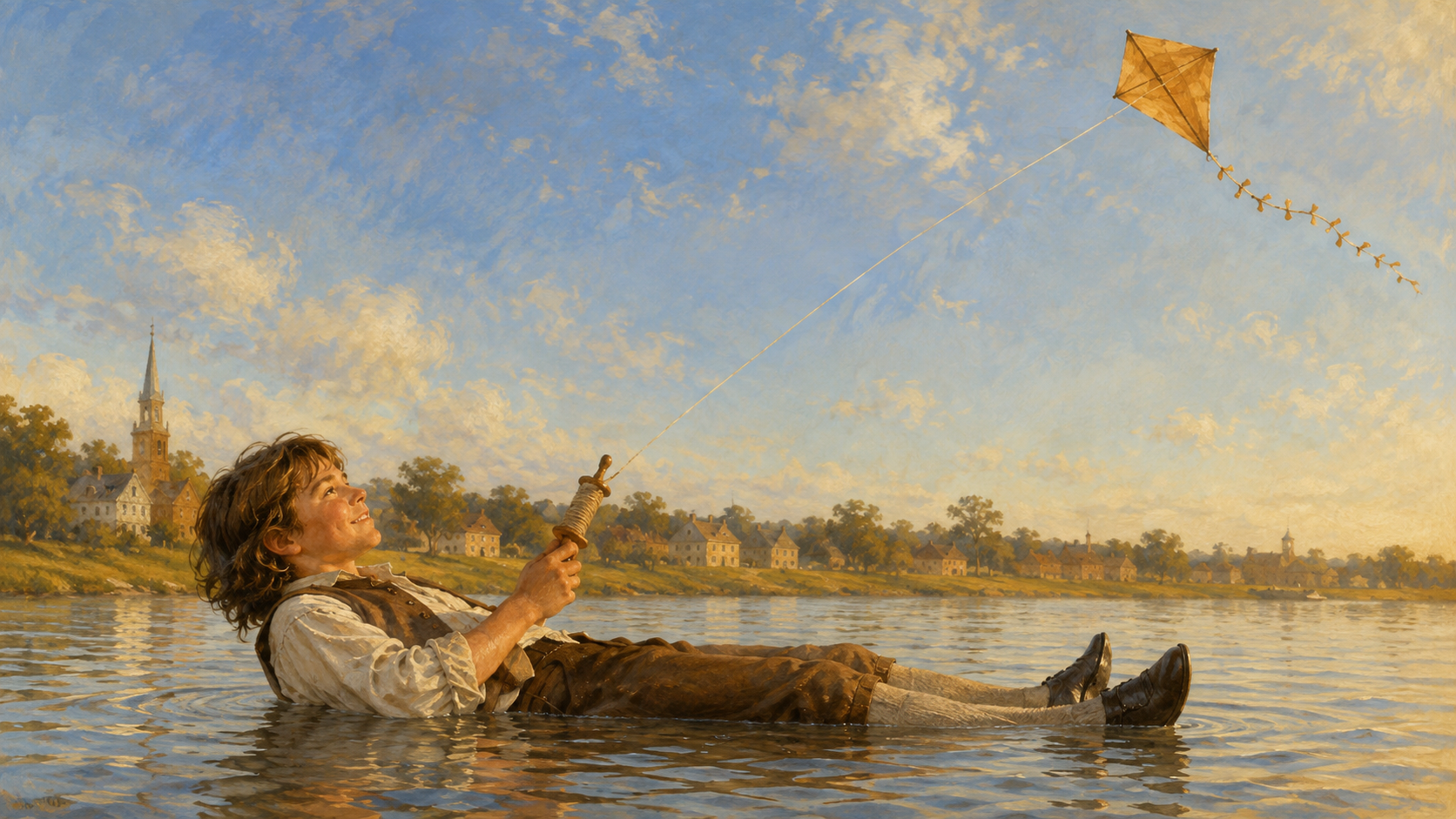
Say “Benjamin Franklin” and “kite,” and most people picture a storm cloud, a key and an experiment with electricity. Franklin did become famous for investigating lightning with a kite in 1752. But in a much gentler kite story, the only current was in the water—and the experimenter was a boy trying to make swimming even more enjoyable.
Franklin later recalled that he used a paper kite to pull himself across a broad pond while he floated on his back. He even arranged for another boy to carry his clothes around to the far side. It is a wonderfully practical detail. A young inventor might solve the problem of wind-powered travel, but somebody still had to deal with the dry clothes.
The episode is charming because Franklin did not turn it into a grand prophecy. He remembered the pleasure, explained the small adjustments that kept the kite aloft, and finished with a joke. It is also a useful example of how to tell a true life story honestly: preserve the fun, but be precise about what the evidence can prove.
A kite above the swimming pond
In Franklin’s first-person account, later published among his collected writings, he described flying a paper kite near a pond that he remembered as nearly a mile across. He tied the string to a stake so that the kite could stay in the air while he went swimming.
Soon, he wanted to enjoy the kite and the water at the same time. He returned to shore, freed the string and took the small stick attached to it back into the pond. Lying on his back and holding the stick, he discovered that the kite drew him pleasantly along the surface.
That first success prompted a larger test. Franklin asked another boy to take his clothes around the pond to a spot on the opposite bank. Then he set out through the water with the kite providing the pull.
According to Franklin’s own account in his collected works, it carried him across without fatigue and with “the greatest pleasure imaginable.” He was not entirely a passive passenger. When moving too quickly caused the kite to dip, he briefly resisted its pull so it could rise again.
The experiment was clever, but the ending makes the memory. Franklin wrote that he never practised this unusual kind of swimming again. He thought crossing from Dover to Calais that way might be possible, then added: “The packet-boat, however, is still preferable.”
That is a fine old joke: propose crossing the English Channel by kite, then recommend buying a ticket.
Not the thunderstorm story
This pond crossing should not be confused with Franklin’s later electrical experiment. The National Park Service’s account of Franklin’s science discusses both episodes separately. It describes his youthful love of swimming and kite-powered crossing, then identifies the famous electrical kite experiment as an event of June 1752.
The distinction matters because Franklin’s public image can flatten several different stories into one symbol. The familiar older statesman with a kite is only part of the picture. Before the political documents, scientific reputation and solemn portraits, there was also a boy interested in what his hands, the wind and the water could do together.
Swimming was not a passing curiosity. Franklin also remembered making oval wooden paddles for his hands and trying sandal-like devices on his feet. The hand paddles made him faster but tired his wrists; the foot devices disappointed him because they did not match how a swimmer actually pushes against the water. The Franklin Institute’s biographical FAQ likewise records his early swimming devices and describes him as an avid swimmer.
Those trials add texture to the pond story. Franklin was not simply struck by one lucky gust. He had been experimenting with movement in water, noticing what helped, what tired him and what failed. His recollection includes both successful and unsuccessful ideas.
We should resist giving the episode a modern label that Franklin never used. It was not a formal demonstration of today’s kitesurfing equipment, and his paper kite was not a modern traction kite. The verified claim is narrower and more delightful: Franklin said that, as a boy, he floated on his back and let a kite pull him across a pond.
What is verified—and what remains a recollection
There is an important difference between proving that an event was independently witnessed and proving that a person documented it.
The primary evidence here is Franklin’s retrospective account. An authoritative National Park Service history repeats the pond crossing as part of his youthful experimentation. Together, those sources give us strong grounds to say, “Franklin recalled doing this,” and to describe what he wrote.
They do not give us a signed statement from the unnamed boy who carried the clothes. Nor do they establish the pond’s exact location in the sources used here. Franklin’s phrase “near a mile broad” is his remembered estimate, not a modern survey. A trustworthy retelling should not fill those gaps with a named companion, invented conversation or a precisely mapped shore.
That careful language does not make the story dull. It makes clear where the colour comes from. The stick in Franklin’s hands, his pause when the kite flew too low, the clothes travelling by land and the final packet-boat joke all come from his own telling. We can enjoy them without pretending that a camera recorded the scene.
This is a useful habit for family history too. “My grandfather said he crossed the lake during a storm” is meaningful evidence of what your grandfather remembered. A dated letter, newspaper report or second witness may confirm more. Until then, attribute the account to him rather than quietly turning every detail into an established fact.
Why small logistics make a story live
Franklin’s account contains the sort of detail people often remove when summarizing: he needed his clothes on the other side.
Yet that practical problem gives the episode its shape. It tells us there was a destination, another person was present, and Franklin expected his experiment to work well enough that he planned for arrival. Without the clothes, the story is merely “a kite pulled a swimmer.” With them, it becomes a scene.
When recording one of your own curious memories, try four questions:
- What ordinary problem had to be solved before the experiment or adventure could begin?
- Who helped, even if they were not the centre of the story?
- What small adjustment kept the plan working?
- What did you say later that still makes people smile?
There is no need to improve the answers. If you do not remember a person’s name, write “another boy,” “a neighbour” or “someone from work.” If the distance is uncertain, say so. If a family punchline survives but its exact wording does not, summarize it instead of adding quotation marks.
These limits can become part of the story’s character. “I cannot remember which cousin carried the towels, but I remember that she reached the beach before we did” is both honest and vivid.
Preserve the episode behind the familiar name
Famous lives are often reduced to one image. Family lives can be reduced in much the same way: the job title, the wedding portrait, the military uniform, the role of parent or grandparent. A playful experiment, an improvised solution or a dry final remark may reveal a different side.
Memory Share offers a place to preserve those episodes before they are compressed into a single family label. If you are ready to begin, this guide explains how creating memoirs can become easier. Start with one incident, identify whose account it is, record the useful little logistics, and leave uncertain details uncertain. Your story matters to us.
What is the lesser-known family story hiding behind someone’s most familiar photograph or achievement?
Sources and further reading
Your story is worth preserving too.
Create and preserve your memories. Write them, record them by voice, and add photos when you are ready.
Preserve your memoriesReactions
Comments
No comments yet.