The Secret Journal Beatrix Potter Could No Longer Read
Before Beatrix Potter became famous for Peter Rabbit, she kept a private journal in a cipher built from substituted letters, characters from several alphabets, and number shortcuts. She eventually became unable to read her own coded writing, and no key survived. Beginning in 1952, engineer and Potter scholar Leslie Linder spent six years deciphering it. A reference to Louis XVI and the year 1793 finally gave him the clue he needed. The recovered pages revealed Potter’s humour, daily observations, artistic development, scientific interests, and attachment to the Lake District. Even an American gingerbread recipe appeared among coded scraps later studied by the National Trust. The story offers a light reminder for today’s memory keepers: protect your privacy, but leave enough names, dates, explanations, and instructions for future readers to understand what you choose to preserve.
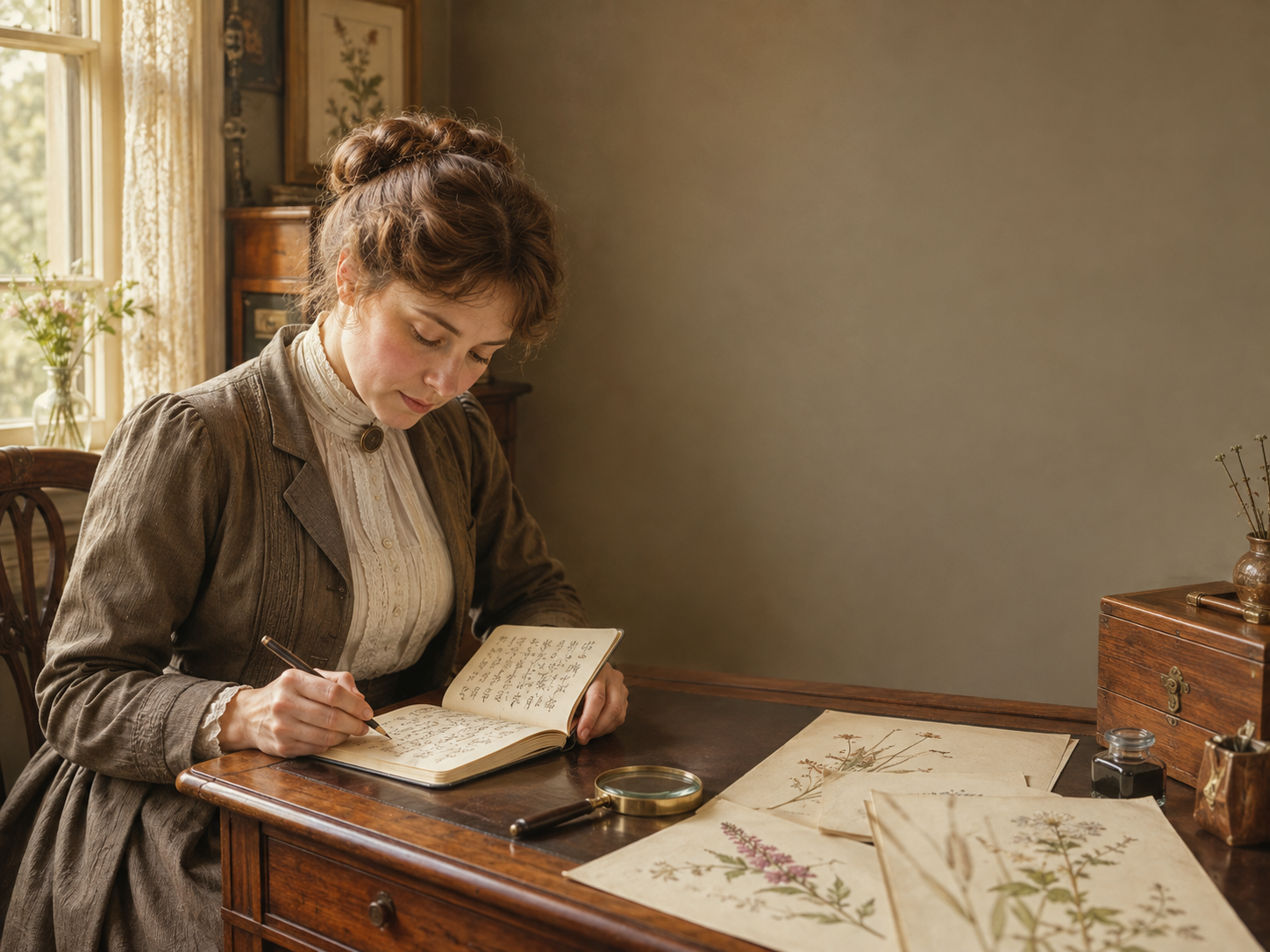
Imagine finding a relative’s old journal and discovering that every page is written in code. Then imagine learning that the writer had become unable to read it herself.
That was the curious fate of Beatrix Potter’s private journal. Long before Peter Rabbit slipped into Mr. McGregor’s garden, Potter filled exercise books and loose sheets with observations, opinions, jokes, artistic ambitions, scientific interests, and details of daily life. She protected much of it with a cipher she could once write fluently from memory.
Decades later, the code had outlasted its key—and almost outlasted its meaning. Recovering the journal required six years of persistence from an engineer and Potter enthusiast named Leslie Linder. His breakthrough arrived through one date, one historical clue, and a great deal of patient checking.
It is a delightful story about privacy, ingenuity, and the odd ways personal memories travel through time. It also raises a question for anyone preserving a life story: how much context will a future reader need before private marks become meaningful again?
A journal before the famous books
According to the Victoria and Albert Museum’s account of the journal and its decoding, surviving material shows that Potter began keeping the journal at least as early as age 14. Its last full entry dates from 1897, when she was 30 and working on her study of fungi. The V&A describes the published transcription as covering about 15 years of her life before she became known for her storybooks.
This matters because the journal does not begin with the famous author looking back on her success. It preserves the younger Potter while her interests were still forming. She wrote about art exhibitions, drawing lessons, pets, fossils, fungi, family holidays, overheard jokes, newspaper items, and the small irritations of Victorian daily life.
The person on those pages was observant and often funny, but she was not writing for an audience of millions. She was making a private space in which she could notice, experiment, complain, and practise telling a story.
A cipher with surprisingly modern shortcuts
Potter’s system was a substitution cipher: ordinary letters were replaced with characters drawn from several alphabets, including Greek and Cyrillic, plus a few numbers. It was not merely decorative handwriting. Without the correspondences between symbols and letters, the journal resisted ordinary reading.
Some shortcuts sound strikingly familiar to anyone who has sent a quick text message. The V&A explains that Potter used the numeral 3 for “the,” while 2 and 4 could stand for sounds or words such as “to” and “for.” She could combine them with letters in forms comparable to “4get” and “2gether.” More than a century before mobile-phone abbreviations, efficiency had found a way onto the page.
Why did she write in code? The V&A cautiously suggests that she may have wanted to keep family members or household servants from reading candid observations about relatives and acquaintances. That is a plausible interpretation, not a documented declaration of motive. What is certain is that she used the cipher so regularly that she no longer needed a written key.
That fluency created the later problem. No key survived.
When the writer lost the way back in
Late in Potter’s life, she referred to the coded material in a letter to her cousin Caroline Clark. Both the V&A and the National Trust record her admission that she could no longer read the cipher, even with a magnifying glass.
There is gentle comedy in that confession. Potter’s privacy system had worked so thoroughly that it eventually excluded its inventor. Yet the loss was real: observations once easy to write had become inaccessible marks.
After Potter’s death in 1943, her cousin Stephanie Duke discovered roughly a dozen exercise books and other coded pieces at Castle Cottage in Near Sawrey. In February 1952, Stephanie and her husband visited Leslie Linder, whose growing research and collection were helping people understand Potter as more than the creator of familiar children’s books. They invited him to examine the mysterious papers.
Linder was an engineer by profession, with expertise in lifting equipment used to load cargo. Deciphering a Victorian journal was not his day job. But his methodical habits turned out to suit the task remarkably well.
Six years, then one useful date
Linder photographed and enlarged the journal pages. He copied their layouts line by line, leaving blank spaces where words still defeated him. Abbreviations added confusion: the same short form could refer to either grandmother or grandfather. He consulted reference books to test possible readings against facts and dates.
For six years, the symbols refused to yield a dependable route into the text.
The breakthrough came on Easter Monday, 6 April 1958. Near the bottom of one page, Linder noticed the Roman numerals XVI beside the number 1793. He reasoned that the number might be a year and checked an almanac for a historical event that fit the surrounding pattern. A long coded word included a familiar “x” between two repeated characters. Linder tested “execution,” connecting the passage to Louis XVI and the year of the French king’s death.
The guess fit. Within six hours, the V&A reports, Linder had decoded the sentence and worked out much of Potter’s alphabet.
It was not magic, and it was not a lucky guess left untested. A date suggested a subject; the letter pattern suggested a word; outside references helped confirm the interpretation. Linder then continued the slower work of transcription and verification. The completed journal was published in 1966, the centenary of Potter’s birth.
What had been hiding in plain sight
The recovered pages revealed no single dramatic secret. Their charm lies in the range of Potter’s attention.
She recorded pets and people, art and science, country walks and urban annoyances. The journal traced her growing attachment to the Lake District, where she would later buy Hill Top. It also documented her serious study of fungi and the preparation of a scientific paper that was presented on her behalf to the Linnean Society in 1897.
The code held humour as comfortably as ambition. Potter described awkward excursions, quarrels over practical matters, and animals whose behaviour she watched with the sharp eye that would later animate her books. Linder’s work helped restore the developing artist and naturalist behind the celebrated name.
The story also continues. In its account of coded pages displayed at Hill Top, the National Trust explains that some loose sheets and scraps were not included in Linder’s published transcription. For a 2025 display, a collections team member used Linder’s alphabet to decode additional material, including an American gingerbread recipe. Other coded sheets contained well-known Scottish poems, perhaps copied as cipher practice.
That detail makes the archive more endearing. A secret code need not guard only secret thoughts. Sometimes it protects—or simply plays with—a recipe.
Privacy now, understanding later
Potter’s journal does not teach that private writing should always be opened. Living writers deserve control over what they share, and families should treat personal papers with care. The story does suggest a gentler practical lesson: if you hope your records will someday be understood, leave future readers a little orientation.
You might label people by full name at least once, add dates and places, explain family nicknames, or keep a sealed note describing abbreviations. If a private journal is not meant to be shared during your lifetime, say what should happen to it later. Context can respect privacy while preventing an important record from becoming an unsolvable puzzle.
And a journal need not be elaborate to matter. If Potter’s mixture of routines, interests, jokes, and observations inspires you, try recording one ordinary day with a few concrete anchors. Preserve what happened, who was there, where you were, and the detail that made the moment yours.
Memory Share can give those recollections a home in writing or in your own voice. Your story matters to us, whether it concerns a life-changing decision, a difficult artistic ambition, or a recipe you would rather keep in code.
What small detail from your daily life would puzzle—and delight—a reader a hundred years from now?
Sources and further reading
Your story is worth preserving too.
Create and preserve your memories. Write them, record them by voice, and add photos when you are ready.
Preserve your memoriesReactions
Comments
No comments yet.