What Was School Like Before the Bell? A Two-Generation School-Day Interview
School memories become richer when a family asks about one ordinary day instead of requesting a complete childhood history. This guide offers a two-generation interview built around the journey to school, the objects carried, classroom routines, friendships, and the walk home. Matched questions give both people a turn and keep the conversation specific rather than turning it into a contest between “then” and “now.” Drawing on Smithsonian and oral-history guidance, it recommends consent, open-ended questions, careful labelling of uncertainty, and a review of the final recording or notes by the person who spoke. A Memory Share subscription can make the project a meaningful gift when paired with an hour of listening and recording. The practical takeaway is simple: start before the bell and preserve the ordinary details that official records rarely contain.
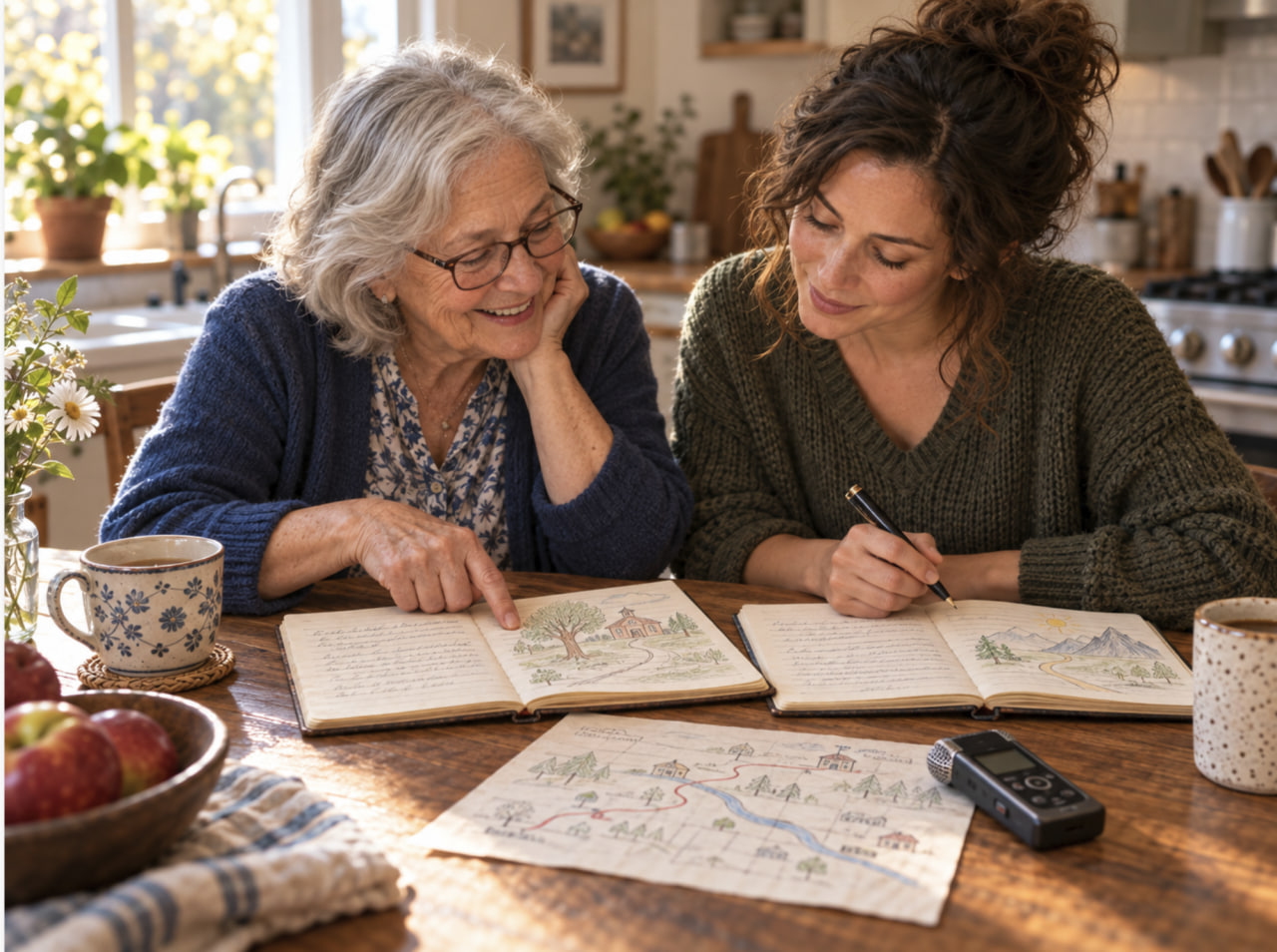
“What was school like when you were young?” sounds like an easy question. It is also so broad that the answer may become a list: the name of a school, a favourite subject, a teacher, perhaps a story everyone has heard before.
Try making the doorway smaller. Ask an older relative to walk you through one ordinary school day, from getting ready to arriving home. Then answer the same questions about a school day from your own childhood or adolescence. The point is not to decide which era was better. It is to preserve two particular lives: the route, the objects, the classroom habits, the people, and the small surprises that made a day feel normal.
This gives each person a turn. The older relative is not treated as a display of “how things used to be,” and the younger person is not reduced to interviewer or archivist. You are making a shared record.
Begin with an invitation and a clear boundary
Ask first: “Would you like to compare one school day from your childhood with one from mine?” Explain whether you hope to write notes, make an audio recording, or do both. Agree on who may see the result. A family conversation deserves consent even when it will never enter a formal archive.
The Smithsonian Institution Archives describes oral history as a way of preserving people’s voices, memories, and perspectives in their own words. Its guidance recommends explaining the purpose and likely use of an interview, allowing the narrator to choose what to answer, and making clear that the recorder can be turned off at any time. The Oral History Association likewise emphasizes informed consent and respect for the narrator’s control over participation.
Keep the first session manageable. Twenty or thirty minutes is enough for one school day. Choose a comfortable, quiet place. If you record, begin by saying the date, location, names of the participants, and the subject. Ask permission again on the recording. These simple details will help a future reader understand what they are hearing.
Ask about the journey before the classroom
Start with the part of the day that often disappears from official records: getting there.
Ask your relative:
- What time did you usually leave home?
- Who travelled with you, if anyone?
- Did you walk, take a bus or streetcar, ride a bicycle, or get a lift?
- What did you pass on the way?
- What happened if you were late, lost, or caught in bad weather?
Then answer the same questions yourself. A route can reveal more than a school address. It may bring back a shop where someone bought a snack, a neighbour who joined the walk, a shortcut through a park, or the particular place where friends separated. If the route has changed, make that comparison specific: what is there now, and what did the older person remember there?
Do not assume that a remembered route is a surveyed map. Add a sketch afterwards, labelling it as memory. Keep maps, school records, timetables, or family documents in a separate note: they may clarify a place or date, but cannot replace the person’s experience.
Let ordinary objects do some of the asking
You do not need a surviving schoolbag or report card to begin. Ask what the student carried or used:
- What was in your bag or pockets?
- Did you bring lunch, and what did it look like?
- Which notebook, pencil, book, instrument, uniform item, or piece of sports equipment mattered to you?
- What did you borrow, trade, repair, or try not to lose?
- Was there an object you wished you had?
The details connect a school day to a household. Who packed the lunch? Who mended the clothing? Did a parent, sibling, friend, or teacher teach you how to care for something?
Handle objects with care and permission. A surviving object is evidence that it existed, not proof of every story attached to it. If a relative shows you a medal, book, or notebook, record what they know about it and mark what is uncertain. The story is in the relationship between the person and the object, not just in the object itself.
Compare the classroom without turning it into a contest
Now move inside the school. Ask one question at a time and let the answer widen naturally:
- What did the room look and sound like before the teacher arrived?
- Where did you sit, and how were seats assigned?
- What happened at the beginning of the day?
- Which subject felt easy, difficult, useful, or mysterious?
- Who helped you learn something you could not do at first?
- What rule did students understand without anyone explaining it?
The Smithsonian recommends open-ended prompts such as “tell me about” and “describe,” along with patient follow-ups like “who,” “where,” “when,” and “how.” It also cautions against leading questions, which can push a narrator toward the interviewer’s expected answer. Instead of asking, “Was your teacher very strict?” try, “What happened when someone broke a classroom rule?”
Avoid the argument that “school was harder then” or “school is harder now.” Ask for the homework assignment, sound of the bell, way group work was organized, or moment a teacher noticed an ability. You may discover that the two days share more than expected—or that a small difference mattered deeply.
Follow the people, not only the timetable
School memories are social records. Ask who sat nearby, who walked home with the student, who made them laugh, who offered help, and who was missed. A name without context may mean little to someone reading the story decades later, so invite a description: “How did you know them?” “What did you do together?” “What would I have noticed about them?”
Make room for people outside the classroom too. A crossing guard, bus driver, librarian, caretaker, coach, older sibling, or lunch supervisor may have shaped the day, even if they vanish from formal school summaries.
If the conversation touches on bullying, exclusion, poverty, discrimination, family difficulty, or another painful experience, do not press for a dramatic ending. Offer a pause. Say that the person can skip the subject. A meaningful record does not require every difficult detail, and a family member should not have to perform pain in order to prove that their school life mattered.
End with the walk home and one lasting change
The last part of the day can be as revealing as the first. Ask:
- What happened after the final bell?
- Where did you do homework, if you did it?
- What did you tell someone at home?
- What did you look forward to the next morning?
- Is there anything from school that stayed with you into later life?
That final question should remain open. The answer may be a friendship, a confidence, a practical skill, a fear, a way of speaking, or simply the habit of watching the clock. Do not force the memory into a lesson. Let the person decide what lasted.
Afterward, record the participants’ names, approximate ages, school and location, interview date, file location, and documents consulted. Share the summary with the person who spoke and invite corrections or private removals.
You can preserve the exchange as two small chapters—“A School Day Then” and “A School Day Now”—followed by a page titled “What surprised us.” The Canadian Museum of History’s scrapbook guidance offers a similarly approachable idea: add one or two pieces at a time, date them, and keep the collection somewhere safe. A school-day record might include a route sketch, a short transcript, a timetable, a lunch description, or a note about an object. It does not need to be elaborate to be useful.
Make the gift a shared hour
A Memory Share subscription can be a meaningful intergenerational gift when it arrives with time and participation. Offer to sit together, ask the questions, record the voice, and review the saved memory. The gift is not an assignment to reconstruct a whole childhood. It is an invitation to say, “I want to know what an ordinary day felt like for you.”
For a related format, see our guide to a same-age family conversation, which uses matched questions to give two generations equal space. When the interview is finished, a note for a future reader can add the context that a school name or photograph cannot carry by itself.
Ask, “Take me through one school day.” Start before the bell, listen for people and objects, and save uncertainty with the detail.
Your story matters to us.
Sources and further reading
Your story is worth preserving too.
Create and preserve your memories. Write them, record them by voice, and add photos when you are ready.
Preserve your memoriesReactions
Comments
No comments yet.