Meet Your Relative at the Same Age: A Two-Way Family Conversation
A relative can feel permanently fixed in a family role: parent, grandparent, aunt, or uncle. A same-age conversation offers a different view. Choose an age both people have lived through, then take turns answering matched questions about an ordinary morning, work or study, friendships, uncertainty, and hopes for the future. The method replaces broad claims about “your generation” with specific scenes and gives both participants a voice. This article explains how to ask permission, use open-ended follow-ups, respect private subjects, distinguish remembered experience from verified facts, and save enough context for future listeners. The practical takeaway is simple: begin with one age, five questions, and two storytellers. When a Memory Share subscription is given with time and help, it can feel less like homework and more like a genuine gift of attention.
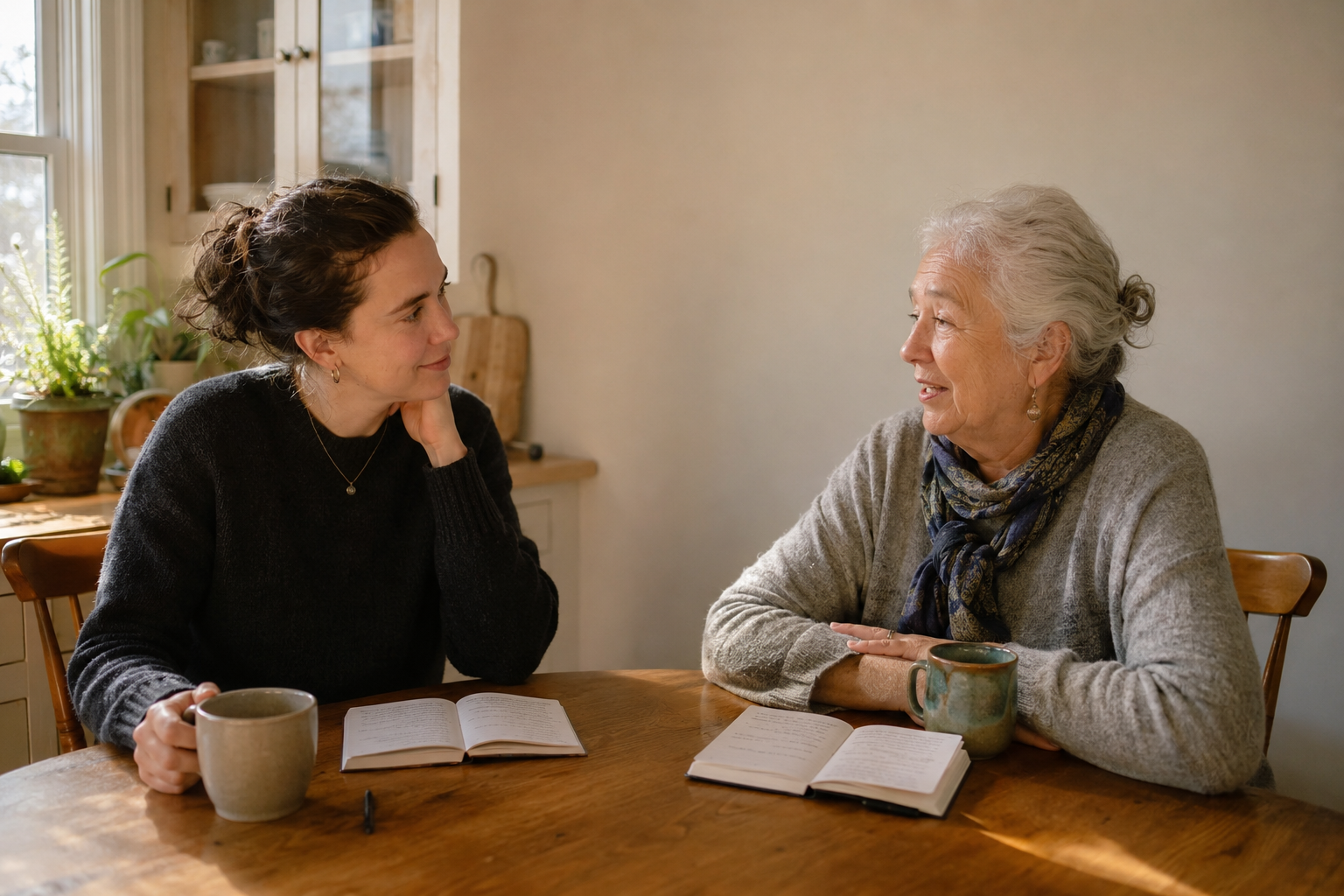
It is easy to know someone only by the role they have in your life. Mum is Mum. Grandpa is Grandpa. An aunt may seem to have arrived in the world already knowing how to make a budget, choose sensible shoes, and remind everyone to take leftovers home.
But who was that person before the familiar title settled around them?
One way to find out is to meet at the same age. Choose an age both of you have lived through—18, 25, 30, or another meaningful point—and answer the same questions about it. What did a normal morning look like? Who mattered most? What felt uncertain? What did each of you expect would happen next?
This is not a quiz about which generation had life harder, cheaper, slower, or better. It is a two-way family conversation. The older person is not treated as a museum exhibit, and the younger person is not merely the one holding the recorder. Both are storytellers.
Why the same age is a useful frame
“Tell me about your youth” is generous but enormous. It asks someone to select one answer from years of school, work, friendships, moves, disappointments, jokes, and ordinary Tuesdays. A shared age gives the conversation a smaller doorway.
The comparison also makes room for difference without forcing a verdict. The point is not to make the lives match. The point is to notice what each person considered normal at the time.
The Canadian Museum of History describes a life-history interview as a kind of co-created oral autobiography. That idea is especially helpful within families: a recorded story is shaped by the person remembering and by the person listening, asking, and responding. A same-age exchange makes that collaboration visible because each participant contributes a piece of the record.
Start with an invitation, not an ambush
Ask before opening a recording app. Explain the idea simply: “Could we compare what life was like for each of us at 25? I would love to save both of our answers.” Agree on whether the conversation will be recorded, who may hear or read it, and whether either person may remove something later.
These courtesies are not fussy extras. The Oral History Association’s best-practice guidance emphasizes informed consent, clear expectations, and respect for a narrator’s right to decline subjects or restrict access. A family recording does not need to become a formal archive, but it still deserves the same basic respect.
Choose a quiet, comfortable time and keep the first session modest—perhaps 30 or 40 minutes. If a topic is painful, private, or simply unwelcome, move on. “I would rather not discuss that” is a complete answer.
Choose one age and build five matched questions
Pick an age that has meaning for both people. It might be the younger person’s current age, the age when both first lived away from home, or the age at which a major family change occurred. Then use five themes. Take turns answering each one before moving to the next.
1. Begin with an ordinary day
Ask: “At this age, where did you wake up, and what usually happened during the first hour of your day?”
This invites a scene rather than a summary. Listen for the room, the people nearby, the journey to work or school, and the first task. Then answer it yourself. Two morning routines can reveal more than a debate about whether life was “simpler then.”
Useful follow-ups include:
- Who else was there?
- What could you hear?
- Which part of that routine did you enjoy?
- What happened on a day when the routine went wrong?
2. Ask about work, study, and money
Try: “What work or study filled most of your week, and what did you think it was leading toward?”
Avoid turning this into a comparison of salaries without context. A number alone does not explain housing, family responsibilities, available choices, or what that amount meant to the person. Ask instead about a first pay packet, a supervisor, a skill learned the hard way, or a purchase that required saving.
Then let the younger participant describe the same part of life. The goal is not to decide who worked hardest. It is to preserve two accounts of expectation: what each person believed a job, education, or income might make possible.
3. Find the people beyond the family tree
Ask: “Who did you turn to when you needed company or advice, and how did you usually keep in touch?”
Ask how the friendship began and what they did together. If the person is still known to the family, record enough context for a future reader to understand who they were.
4. Make room for uncertainty
Ask: “What decision or worry occupied your mind at that age, even if it seems small now?”
Do not rush to turn the answer into a lesson. A story is allowed to remain complicated. Perhaps the decision worked out; perhaps it did not; perhaps its importance only became clear later. After listening, share an uncertainty from your own life at that age. Reciprocity can change the tone from an interrogation to a conversation.
5. End by looking forward from the past
Ask: “What did you imagine your life would look like ten years later?”
This separates what the person knew then from what everyone knows now. Follow with: “What happened that you could not have predicted?” The answer may reveal a move, a relationship, an opportunity, a loss, or a wonderfully ordinary surprise. Do not press for drama. A changed commute or an unexpected hobby can be part of a life’s shape too.
Follow the story, not the questionnaire
The questions are guideposts. The Smithsonian Institution Archives’ guide to oral-history interviewing recommends open-ended prompts, one question at a time, close listening, and follow-up questions. It also advises interviewers not to fear silence. A pause may simply mean someone is searching for the right room, face, or sequence of events.
Good follow-ups are small: “What happened next?” “Could you describe that place?” “How did you decide?” If the answer wanders somewhere unexpectedly useful, let it. The best family detail may be hiding beside the question you planned.
Avoid correcting a memory in the middle of the telling. If a date or public event matters, note it for later checking. The Oral History Association advises users to recognize the subjectivity of interviews and, when possible, verify information presented as factual. That does not make a person’s perspective worthless. It simply keeps remembered experience distinct from a confirmed date, name, or historical claim.
Save enough context for the future
With permission, begin the recording by saying both names, the date, the general location, the chosen age, and the purpose of the conversation. Give the file a clear name and keep a backup. A short written note can list the people and places mentioned, especially when nicknames or changed place names may puzzle a future listener.
If recording feels uncomfortable, take notes together instead. The Canadian Museum of History’s family interview activity suggests phone or video conversations, written notes, and transcription as possible ways to document an interview. The useful method is the one both people are willing to use.
Afterward, share the recording or draft with the other participant before giving it to anyone else. Ask whether the title, spellings, and privacy choices are right. You might preserve the exchange as two short chapters—“Nadia at 25” and “Evan at 25”—followed by a page called “What surprised us.”
A gift of attention, not homework
A Memory Share subscription can make a meaningful gift when it comes with participation. Instead of handing someone an account and saying, “Please write your life,” offer a first shared project: one age, five questions, two voices. Help record, transcribe, organize, or review the result. The real gift is not an assignment. It is evidence that someone wants to listen.
One same-age conversation will not explain an entire generation, and it should not try. It can do something more personal: preserve how two people understood life from the same point on two different timelines.
Which age would you choose—and whose answer would you most like to hear?
Your story matters to us.
Sources and further reading
Your story is worth preserving too.
Create and preserve your memories. Write them, record them by voice, and add photos when you are ready.
Preserve your memoriesReactions
Comments
No comments yet.