Map the Place Before You Write the Memory
A memory map can make a vague setting easier to write without pretending every recollection is exact. This practical five-step method begins with one bounded place—a home, workplace, garden, block, or familiar route—and asks the writer to sketch it from memory. People, movement, changes, sensory details, and unanswered questions are added next. Historical fire insurance plans, topographic maps, directories, and local archives can then help check the setting, but records should not be mistaken for proof of personal experience. By labelling details as remembered, documented, or uncertain, a memoir writer can preserve both useful evidence and honest doubt. Finally, one route across the map becomes the backbone of a focused scene, from entrance and destination to interruption and exit.
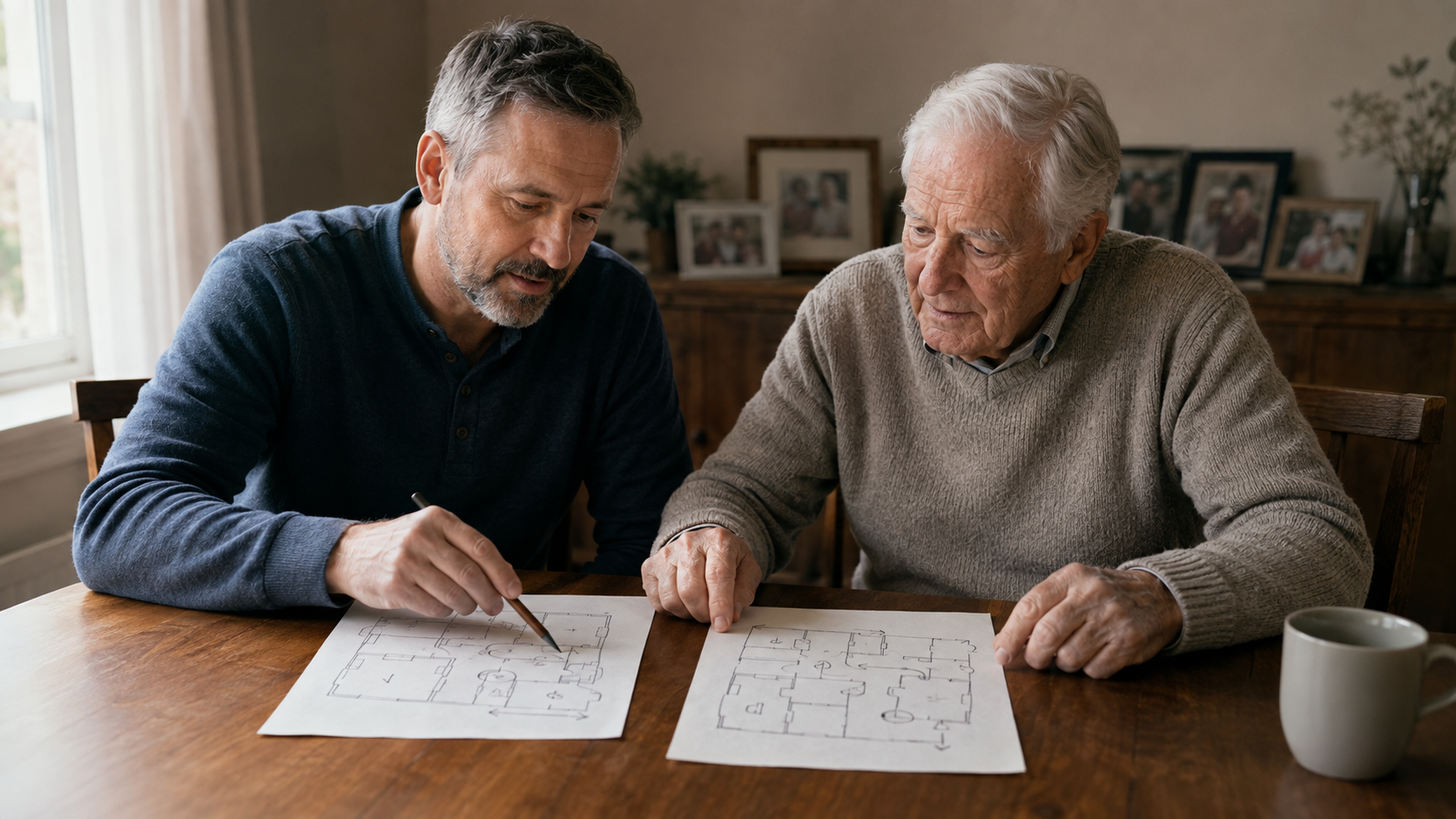
You can remember that the old kitchen felt crowded without remembering where the table stood. You may see the walk to school clearly in fragments—the corner shop, the noisy crossing, the fence you trailed a hand along—yet struggle to put those fragments in order on the page.
Before forcing them into paragraphs, draw the place.
A memory map is not a test of artistic skill, and it is not a claim that every detail is exact. It is a working sketch of one meaningful setting: a home, street, farm, workplace, holiday cottage, school, neighbourhood, or regular journey. By placing rooms, landmarks, routes, and people on paper, you create practical prompts for a memoir scene. You also make uncertainty visible, which is an important part of writing honestly.
Here is a five-step method that needs only paper and a pencil.
1. Choose a place with clear boundaries
Do not begin with “the city where I grew up.” That is too large. Choose a space you could cross in a few minutes, or one short route you knew well.
Good starting points include:
- the ground floor of a childhood home
- the block around a first apartment
- the route from home to a bus stop
- a workshop, shop, classroom, or office
- a grandparent’s garden
- the grounds of a summer camp
Give the map an approximate date as well as a place: “Our flat, around 1978” is more useful than “Our old flat.” Buildings change, streets are renamed, and families rearrange rooms. You are mapping a particular period, not an address for all time.
Then choose one question for the scene you eventually want to write. For example: Why did I dread walking past that house? What made Sunday lunch feel different from every other meal? When did I first feel capable at work?
The question gives the map a purpose.
2. Draw from memory first
Make the first version without consulting a current online map or family records. Draw only what you presently remember. Accuracy can wait.
Start with a simple outline. Add doors, paths, intersections, rooms, fences, trees, counters, staircases, or other fixed points. Then add the places where life happened: the chair where someone always sat, the doorway where muddy shoes collected, the corner where friends waited, or the cupboard nobody was supposed to open.
Use words freely. A rectangle labelled “Mr. Chen’s shop” is better than an elegant but meaningless building. Arrows can show movement. A dotted line can mark an uncertain boundary. A question mark is useful evidence about the limits of your recollection.
Try these prompts while drawing:
- Where did people enter, pause, and leave?
- Which route did I take most often?
- Where was I allowed to go, and what was out of bounds?
- What could I see from the window or doorway?
- Where did adults talk when they thought children were not listening?
- Which object seemed permanently attached to this place?
- Where did noise, heat, cold, or a particular smell come from?
- Which part of the map feels oddly blank?
Do not add a detail simply because it would make a prettier story. Write “possibly,” “I think,” or “ask Sam” beside anything uncertain.
3. Add people, movement, and change
A floor plan alone may describe a building, but a memoir needs lived activity. Use a second colour to mark people and movement.
Who usually occupied each area? Where did visitors sit? Which person moved briskly through the space, and who lingered? Mark repeated routes, such as the path from the back door to the washing line or from a desk to the time clock. Then mark exceptions: the day everyone crowded into the hall, the season a room changed use, or the shortcut taken only once.
Next, add a small “before and after” note. Perhaps a field became housing, a bedroom changed occupants, a store closed, or a wall was removed. This is not the same as building an entire life timeline. The aim is to notice how one setting changed and what that change meant to the people using it.
If several relatives shared the place, invite them to draw separate maps before comparing notes. Do not make one person’s version the answer key. Two maps may disagree because people used the space differently, lived there at different times, or noticed different things. Record the disagreement rather than smoothing it away.
4. Check the setting without replacing your memory
Now consult records. A historical map can confirm a street name, reveal a vanished railway line, or show that a remembered shop occupied a narrow building. It cannot prove what you personally saw, felt, or did.
Authoritative collections can help. The City of Toronto Archives says its fire insurance plans cover dates from 1858 to 1973, with plans from 1880 to 1924 available online, although not every area is covered. The plans provide detailed information about buildings and neighbourhoods. For readers researching other communities, municipal archives, libraries, land registries, directories, and local-history collections are sensible places to ask.
The Library of Congress explains that Sanborn fire insurance maps cover commercial, industrial, and residential areas in thousands of communities in the United States, Canada, and Mexico. Because the maps were created to assess fire risk, they can show building size, shape, construction, street names, property boundaries, building use, and house or block numbers. Their original purpose matters: they are detailed records, but they were not made to document every aspect of family life.
For places in the United States, the U.S. Geological Survey’s Historical Topographic Map Collection includes scanned maps originally printed from 1884 to 2006. USGS notes that comparing editions can reveal changes in physical and cultural features over time. A topographic map may therefore help with roads, waterways, railways, settlements, and changing development at a wider scale.
On your sketch, label every addition:
- M for something you remember
- D for something supported by a document
- Q for a question or unresolved conflict
Keep a note of the record’s title, date, creator, archive, and link or reference number. If a map corrects you, write both versions in your notes: “I remembered the lane behind the school; the 1969 map labels it as an alley beside the grounds.” That distinction preserves the history of your remembering instead of quietly rewriting it.
5. Turn one route into a scene
The finished map is preparation, not the memoir itself. Choose one path across it. A scene often becomes manageable when a person wants something and must move through a particular place to get it.
Mark four points:
- Entrance: Where does the scene begin?
- Destination: Where is the person trying to go?
- Interruption: What changes the expected route or routine?
- Exit: Where does the scene end, physically and emotionally?
Write the action in that order. Let details appear as the narrator encounters them. If the scene begins at the garden gate, there is no need to describe the upstairs wallpaper. If the route passes the bakery vent, a remembered burst of warm air may belong; if it does not, save that detail for another story.
After drafting, ask:
- Could a reader follow the movement without seeing my map?
- Have I included only details relevant to this moment?
- Which statements are memories, and which came from records?
- Have I signalled approximate or disputed details honestly?
- Does the present-day reflection explain why this place still matters?
One map may produce several stories: the hurried morning route, the forbidden shortcut, the room after someone left, or the first return many years later. Save each as a separate piece. If you would like a simple way to collect those pieces, Memory Share’s guide to creating memoirs step by step explains how individual memories can become chapters in a larger book.
Begin with one bounded place and ten quiet minutes of drawing. Put down what you know, mark what you do not, and choose one route through the page. Your story matters to us—and sometimes the way into it is quite literally a map.
Sources and further reading
Your story is worth preserving too.
Create and preserve your memories. Write them, record them by voice, and add photos when you are ready.
Preserve your memoriesReactions
Comments
No comments yet.