The Seaweed Album That Carried a Journey Across Oceans
A nineteenth-century album in the National Museum of Australia holds approximately 200 pressed seaweed specimens and a trail of handwritten clues. The oldest labelled specimen came from the north of Ireland in 1851, two came from the Cape of Good Hope in 1854, and many later examples came from shores around Melbourne. After comparing handwriting and collecting locations, researcher Julie Ryder helped identify Scottish-born migrant Charles Morrison as the likely collector—an attribution the museum states carefully rather than as certainty. The charming mystery shows how an ordinary collection can preserve a journey long after its explanation is lost. Readers are invited to add names, places, dates, reasons, and sources to their own keepsakes, while marking uncertainty honestly, so future family members inherit both the object and its story.
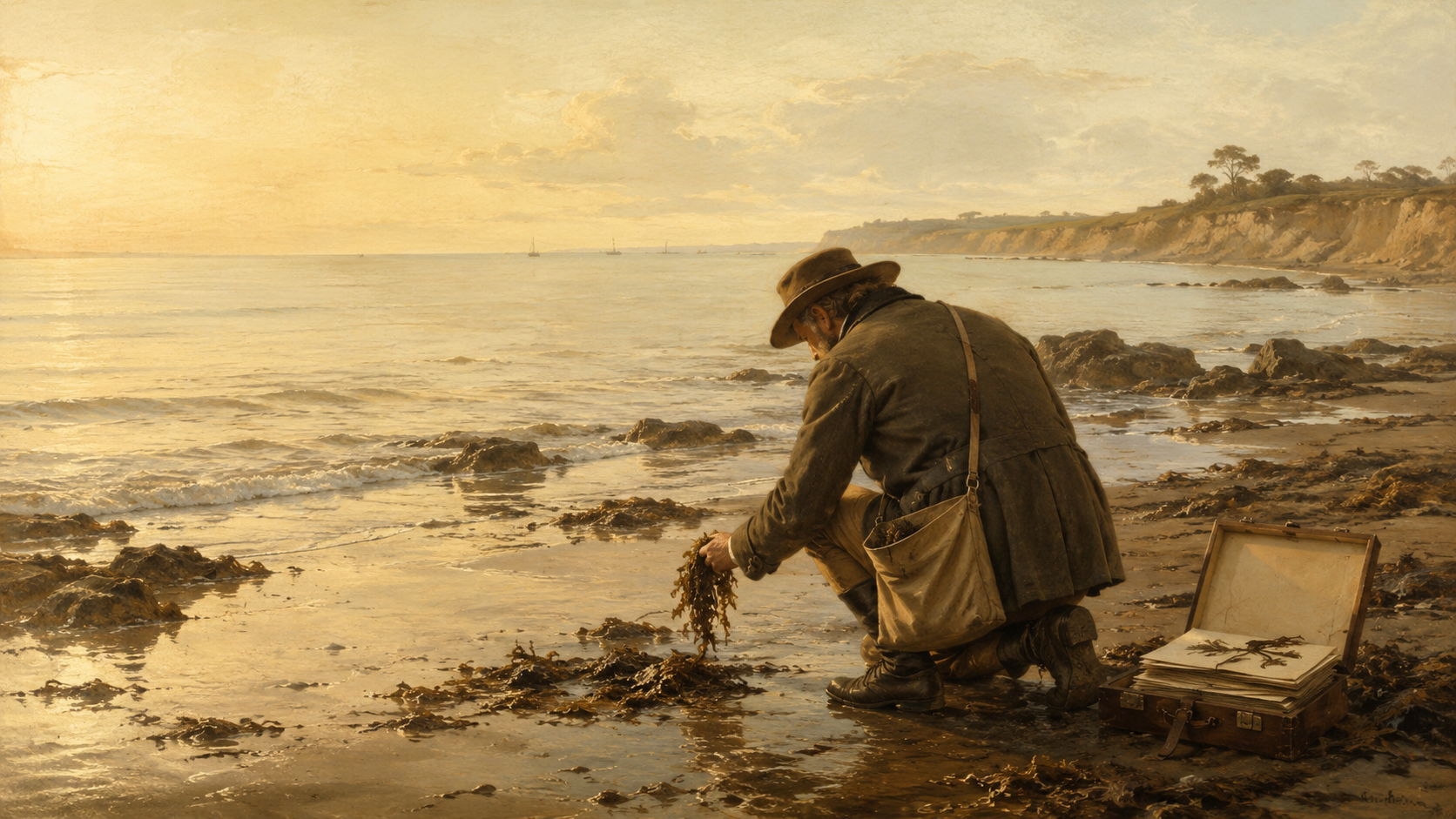
At first glance, the old book seems to contain a beach walk that got wonderfully out of hand.
Across 36 card leaves, delicate red, green, and brown seaweeds spread into fans, ribbons, tiny trees, and tangled underwater gardens. Some specimens are attached directly to the pages; others sit on loose paper held by tabs. A few are arranged decoratively. Many are simply fitted wherever space could be found.
This is the Port Phillip seaweed album in the National Museum of Australia. It holds approximately 200 marine algae specimens, plus a small number of mosses, lichens, and ferns. The plants are beautiful, but the handwritten labels are what turned the album into a trail. Together, they point from the north of Ireland to the Cape of Good Hope and onward to the shores around Melbourne.
For years, however, one crucial label was missing: the collector's name.
A scrapbook, a specimen book, or both?
Pressed seaweed albums occupied a delightful borderland between science, art, and souvenir keeping. The University of Sydney Library's account of two albums in its special collections explains that seaweed collecting and pressing was popular in the Victorian era. Collectors might record scientific names, dates, and places, or arrange the plants into elaborate scenes sometimes called marine paintings.
The method required more care than dropping a shell into a pocket. According to the library, collectors cleaned sand from a specimen, floated it in water so its form opened again, slipped paper underneath, and adjusted the wet fronds before pressing the page. The result could look less like something found at the tide line and more like an ink drawing or watercolour.
The Port Phillip album refuses to fit neatly into one category. In the National Museum's close account of the album and its pages, a curator observed that it is neither a fully systematic scientific collection nor quite a conventional artwork. Only some entries carry dates, places, or scientific names. The collector preserved repeated types of seaweed and, after a decorative opening, often seemed intent on fitting in as many specimens as possible.
The labels became a travel route
The album's oldest dated specimen came from the north of Ireland in 1851. Two specimens were collected at the Cape of Good Hope in 1854. Most of the others came from the Port Phillip area between the 1850s and the 1880s, including places such as St Kilda, Hobsons Bay, Sandridge, Brighton, and Queenscliff.
That sequence suggested a journey. In its formal description of the Port Phillip Seaweed Album Collection, the National Museum says the locations indicate that the creator may have migrated from Great Britain to Melbourne in the 1850s. The wording matters: the specimens provide clues, not a passenger list, and the museum presents migration as a supported possibility rather than a proven fact.
Even so, it is hard not to marvel at the accidental map. A person may have carried the album, its loose sheets, or its specimens across oceans. A wet plant gathered on one shore survived as a flat, fragile marker of place on another continent.
Handwriting returned a likely name
The National Museum purchased the album in 2013, but the collector was then unknown. In 2016, Canberra artist Julie Ryder spent six months researching it. She compared handwriting in the Port Phillip volume with writing in similar albums held by herbarium collections in Melbourne and Sydney. Similar lettering and overlapping collecting locations pointed to Charles Morrison.
The museum now says it believes Morrison collected the specimens, while still inviting further information. Its account of the handwriting investigation identifies him as an amateur Scottish seaweed collector born in Glasgow in 1817. He married Margaret Bell of Londonderry in 1847, and the couple had six children. The family later lived in the Melbourne suburbs of Collingwood and Fitzroy.
The route fits important album clues: Ireland, a stop at the Cape of Good Hope, and then Victoria. But “fits” is not the same as “proves.” The museum's careful language leaves room for another person to have gathered, arranged, contributed, or owned some of the material. A family member might have participated. Specimens might have been exchanged. Until stronger evidence emerges, Charles Morrison is the likely collector, not an excuse to fill every blank with certainty.
That restraint makes the story better, not weaker. Real family history often arrives with a solid centre and soft edges. Good storytelling allows both to remain visible.
A craze made of “flowers of the sea”
Morrison, if the attribution is correct, was not alone in finding seaweed worth keeping. Mid-nineteenth-century interest in marine algae combined natural history, artistic arrangement, and seaside leisure. A recent Natural History Museum history of seaweed recording notes that collecting was a popular hobby among middle-class women in Britain during the mid-1800s. Historical specimens can still connect curiosity on the shore with scientific records today.
The Port Phillip volume belonged to a broader Australian enthusiasm too. Museum research describes a community interested in the scientific study of algae while seaweed shapes also appeared in pictures, albums, and decorative objects. Yet this particular album remains pleasingly individual. It does not need to become a perfect herbarium or polished artwork to deserve attention.
Perhaps that is why it feels familiar. Many inherited collections are similarly mixed: carefully labelled pages followed by mysterious ones; a beautiful arrangement beside a hurried addition; a system begun with enthusiasm and then cheerfully ignored. The unevenness is evidence of a human hand.
What its missing labels can teach us
The seaweed album survived, but much of its personal context did not. We do not have a note explaining why it began, who helped, which shore was a favourite, or why certain specimens were preserved repeatedly. The labels that do remain carried an enormous share of the story.
That suggests a modest practice for our own keepsakes. When you preserve a collection—pressed leaves, ticket stubs, recipes, fishing lures, postcards, buttons, or stones—add five pieces of context where you can:
- Who gathered, made, bought, or received it?
- Where did it come from?
- When was it collected or used?
- Why was it worth keeping?
- Who else would know part of the story?
Do not guess when you are unsure. Write “possibly,” “family tradition says,” or “collector unknown.” Record the name of the person supplying each identification and the date they supplied it. If the collection traces several places or years, a simple factual timeline can help reveal the route before you interpret it.
You need not turn every object into an essay. One index card, a digital note, or a labelled envelope may be enough. The goal is to keep the clue attached to the thing.
Preserve the wonder as well as the facts
There is another lesson in these pages. Documentation matters, but so does the reason someone cared.
A museum can measure an album, identify collection sites, compare handwriting, and examine a specimen under magnification. Those acts recover history. But the object also invites a simpler response: someone looked closely at forms most beachgoers might step over. Again and again, that person chose one, carried it home, opened it in water, guided it onto paper, and waited for it to dry.
When recording a family collection, ask not only “What is this?” but also “What did you love about it?” The answer may preserve humour, taste, patience, or a habit of attention that no catalogue entry can hold.
The Port Phillip album's likely maker left no known explanation for us. Still, his labelled specimens carried a possible life route across three regions and more than three decades. A collection of seaweed became an unfinished travel story—and handwriting helped return a name to its pages.
What ordinary object in your family might already contain a journey, waiting for its clues to be read? Your story matters to us.
Sources and further reading
Your story is worth preserving too.
Create and preserve your memories. Write them, record them by voice, and add photos when you are ready.
Preserve your memoriesReactions
Comments
No comments yet.