Write the Scene You Remember—Then Mark What You Don’t
A partial memory can still become a strong memoir scene. This practical guide introduces a four-column scene inventory: what happened, what you directly remember, what you may be inferring, and what remains unknown. It then shows how to build a draft from physical actions, handle remembered dialogue without false precision, and ask relatives open questions rather than leading them toward your version. The method keeps uncertainty visible while giving a fragment shape and movement. Readers are encouraged to separate the experience as it felt then from the meaning they make of it now, and to seek consent before recording or publishing another person’s story. Begin with one bounded moment, three honest actions, and one question.
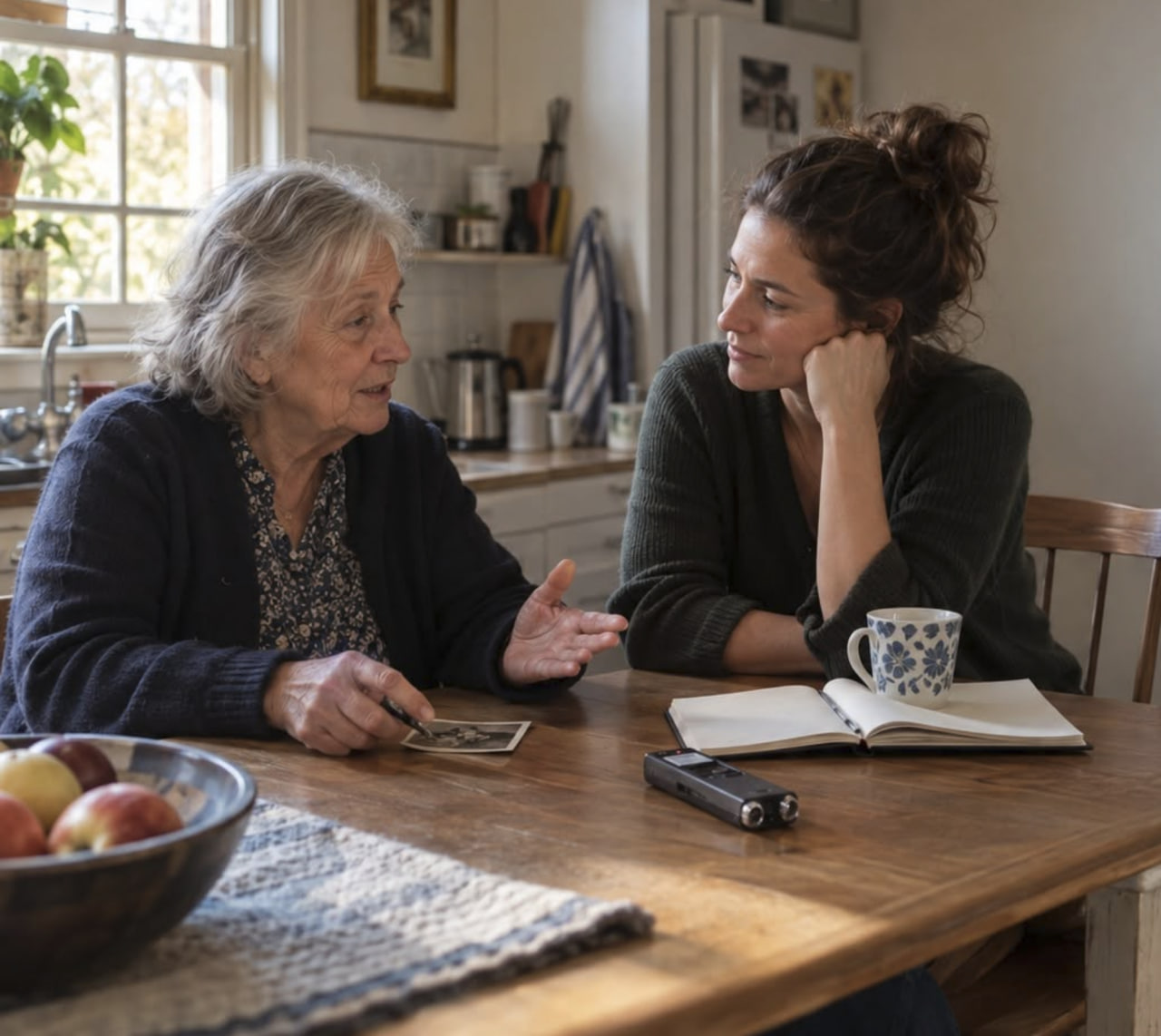
You may remember a family event in flashes: a hand on a doorknob, the scrape of a chair, the sentence someone repeated, the feeling that you needed to leave. Ask for the exact date and whole sequence, however, and the memory becomes less cooperative.
That is not a reason to abandon the story. Change the first task: do not demand a polished scene. Begin with an inventory.
A scene inventory is a short set of notes that separates what you remember happening from what you are inferring now and what you do not know. It gives a partial memory somewhere to stand. It also helps you avoid the tempting habit of filling gaps with details that sound plausible but are not truly yours.
The method is useful for a childhood moment, a first job, a family disagreement, a departure, or any episode with a strong centre but a broken outline. You are not trying to prove that your memory is perfect. You are making its limits visible so the writing can be vivid and trustworthy.
Start with one bounded moment
Choose an episode small enough to hold in one sitting. “My parents’ marriage” is a subject. “The evening my father packed the blue suitcase” is a possible scene. “My first year at the factory” is a subject. “The morning I was shown how to reset the machine” is a possible scene.
Look for a moment with an action, a change, or a decision. Someone arrived, refused, noticed, handed something over, changed direction, or said goodbye. A scene does not need a dramatic ending. It needs a manageable stretch of time in which something was different at the end.
Write a temporary title that includes the action: “The missing key,” “The bus after the interview,” or “Grandmother’s rule about the good towels.” Add an approximate period and place if you can. “Kitchen, late 1970s” is useful; a false precision such as “Tuesday, 14 June 1977” is not.
Now write the memory in three or four unedited sentences. Do not search for the perfect opening. Get the central movement down before the mind begins decorating it.
Make four columns
On paper or in a document, create four headings:
- What happened: actions you remember or can support with a record.
- What I directly remember: sights, sounds, words, bodily sensations, and movements that feel present in your recollection.
- What I may be inferring: explanations, motives, exact wording, or details supplied by later knowledge.
- What remains unknown: gaps, disputed details, missing names, and questions for another person or a document.
The headings are not a verdict on the truth of your life. They are a drafting tool. A detail can move between columns as you learn more. The point is to stop every sentence carrying the same level of certainty.
You do not need to remove emotion. Distinguish “I felt frightened” from “I knew everyone in the room was frightened.” The first reports your experience; the second claims access to other people’s inner lives.
Follow the physical actions
When memory feels thin, writers often reach for explanation: “It was a difficult time,” “We were very close,” or “He was always impatient.” Those statements may be true, but they cover a large area. A physical action gives the reader a place to enter.
List the verbs you can honestly find: folded, waited, carried, wiped, counted, locked, leaned, turned, whispered, checked, ran, or stayed. Then put them in the order you remember. If the order is uncertain, say so in your notes rather than silently arranging it.
Ask where you were standing, what you picked up or carried, who moved first, and what happened immediately before and afterward. Then ask which action you can see and which you are explaining from a distance.
The goal is not to choreograph every second. Replace general summary with a few observed actions. “My uncle was supportive” may become “He moved his chair beside mine and read the form aloud.” If you do not remember the chair, write “He stayed beside me.”
Treat remembered dialogue carefully
Dialogue is powerful and unusually easy to overstate. A sentence remembered word for word after many years may be accurate, but it may also be a compressed version of a longer exchange. Before putting quotation marks around it, ask whether you remember the exact language, the sense of the words, or only the effect they had.
Use quotation marks for wording you genuinely remember and can stand behind. Paraphrase when you remember the meaning but not the sentence. Or write about the voice and response: “She told me to wait. I remember the instruction more clearly than the words around it.”
If you are interviewing a relative to fill a gap, use open questions rather than offering a version for them to confirm. The Smithsonian Institution Archives recommends prompts such as “tell me about” and “describe,” follow-up questions beginning with who, what, when, where, how, and why, and one question at a time. It also cautions against leading questions because they can affect an interviewee’s answer. Those principles work in a family conversation as well as a formal oral-history project. The Smithsonian’s oral-history guide is a useful reference.
Try asking, “What do you remember about that afternoon?” before asking, “Was this when we moved?” Let the other person’s version arrive in its own shape. It may confirm your scene, complicate it, or open an entirely different one.
Keep the gap visible
An unknown is not a writing failure. It can be part of the scene’s meaning. Perhaps you remember waiting outside a hospital room but not who first called you. Perhaps you know a family recipe came from an aunt but not whether she learned it from her mother. Perhaps everyone remembers the move but disagrees about why it happened.
Do not solve these gaps merely because a clean story feels satisfying. Use phrases that accurately signal the distance between then and now: “I think,” “as I remember it,” “the date is approximate,” “my brother remembers this differently,” or “I learned later.” These are not apologies. They are useful guidance for the reader.
The Oral History Association describes oral history as recollection filtered through changing personal and social contexts. Its principles also emphasize planning, consent, transparency, respect, and the narrator’s control over what they choose to share. If another person’s experience is entering your memoir, ask permission before recording or publishing private material, explain how you intend to use it, and allow room for them to decline. Read the Oral History Association’s principles and best practices before beginning a recorded family interview.
You can write a personal memoir without turning every relative into a source or every memory into public property. Some details should remain private; some names can be changed.
Draft in two passes
For the first pass, use only the “what happened” and “directly remember” columns. Let the reader experience the movement. Keep details that make the moment particular: the object handled, the route across the room, the repeated phrase, the pause before someone answered.
For the second pass, add the present-day reflection. What do you understand now that you did not understand then? What remains unsettled? Has another person’s account changed your interpretation? Keep this reflection separate enough that the reader can tell the difference between the younger self’s experience and the older self’s knowledge.
Then read every sentence that contains a motive, exact dialogue, date, or statement about another person. Move it to the inference or unknown column if necessary. Replace certainty with accuracy, not vagueness. “I cannot remember whether it was Thursday or Friday, but I remember the shop was closing” is more useful than a made-up date.
Save the inventory beside the draft. It may become valuable later when a photograph, letter, calendar, or relative’s recollection adds context. If you want a simple home for individual memories, MemoryShare’s guide to creating memoirs explains how one saved memory can become a chapter and later join a larger book.
Begin with the fragment
Choose one memory that has stayed with you even though its edges are incomplete. Give it a temporary title. Make the four columns. Find three physical actions. Mark one uncertainty. Ask one open question, if another person can help and is willing.
That is enough for today’s draft. A memoir does not become honest by pretending every detail is available. It becomes honest when the writer shows what is remembered, what is learned, and what cannot be known. Your story matters to us—including the parts that need a careful question mark.
Sources and further reading
Your story is worth preserving too.
Create and preserve your memories. Write them, record them by voice, and add photos when you are ready.
Preserve your memoriesReactions
Comments
No comments yet.