Ask About the First Home They Remember
An address is only the beginning of a family home story. Invite an older relative to walk through the first home they remember, room by room, and listen for the ordinary details that official records cannot preserve: routines, sounds, neighbours, shared spaces, household rules, and changes over time. Ask permission before recording, use open-ended questions, and let the storyteller skip anything private. A simple hand-drawn map can accompany the conversation, clearly labelled as remembered rather than measured fact. Keep memories, documents, and uncertainties in separate sections so future readers can understand both the story and its limits. This small two-generation project can become a meaningful gift of attention—and a lasting record of the people and places that made a home.
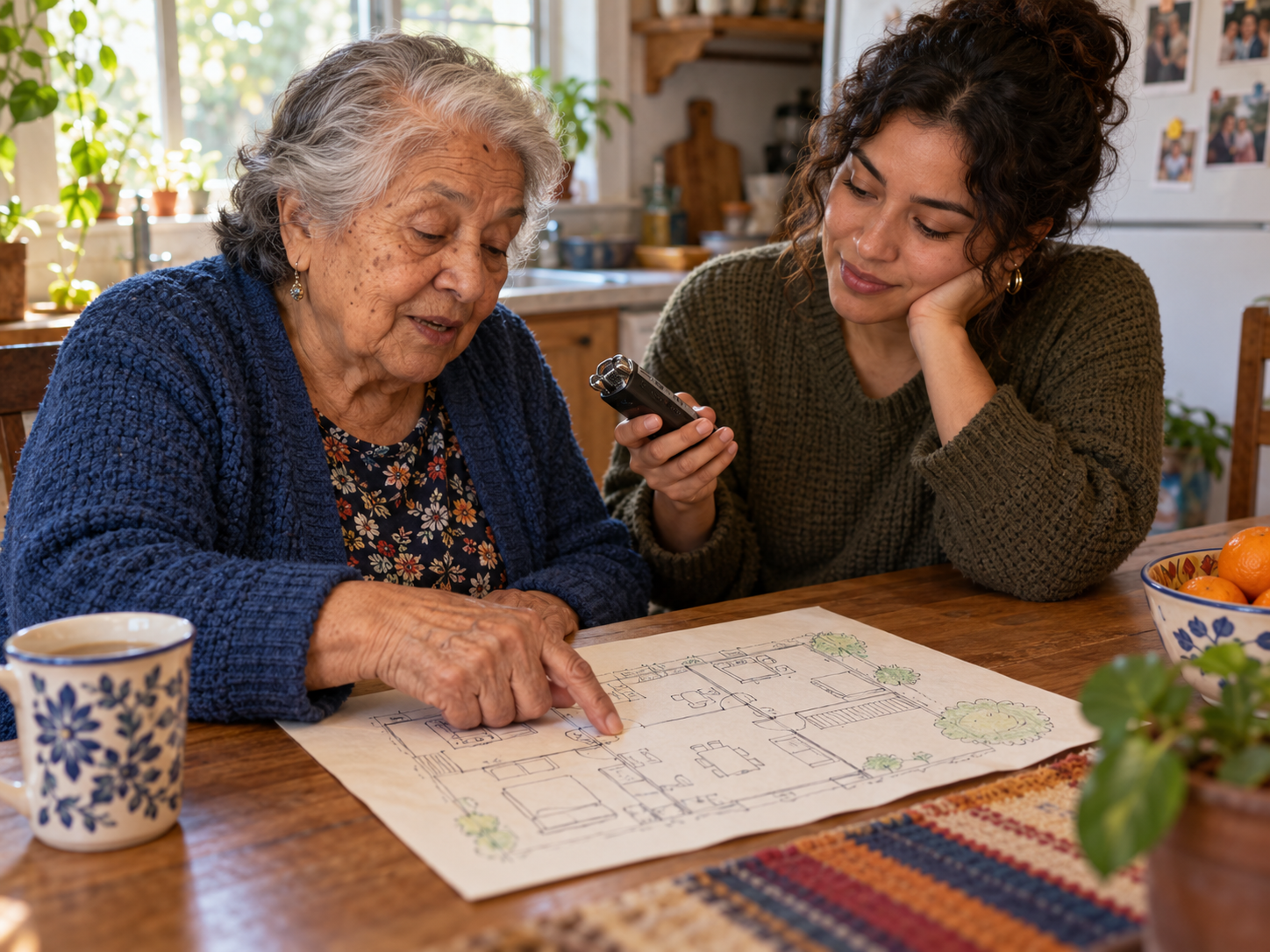
An address can tell you where a person lived. It cannot tell you what the hallway sounded like before school, who sat nearest the stove, which neighbour borrowed sugar, or what happened when the family had to leave.
Those details often live in an older relative’s memory. They may never appear in a family tree, property record, or formal biography. A conversation about the first home someone remembers can open a specific way into family history—one that gives two generations something to do together and leaves a record for the people who come after.
The project needs one person, one remembered home, and enough time to listen carefully.
Begin with the invitation, not the recorder
Start by asking whether your relative would like to talk about the first home they remember. The wording matters. You are offering an invitation, not assigning an interview.
Explain what you hope to make: perhaps a private audio recording, a written family story, or a short memory to keep with photographs and documents. Say who may hear or read it. Ask whether they are comfortable with recording, and remind them that they can pause, skip a question, or stop at any point.
The Smithsonian Institution Archives’ oral-history guide recommends explaining the purpose and likely use of an interview, allowing the interviewee to choose what to answer, and asking open-ended questions. The Oral History Association likewise places informed consent and clear expectations at the beginning of the process. These principles are useful at a family kitchen table too. Trust is part of the record.
If a story includes another living person, be especially careful with private information. You can preserve the memory without publishing every name, address, disagreement, or family explanation. A home story is not a licence to expose someone else’s life.
Ask for a walk through the home
Broad questions can feel like exams. “Tell me everything about your childhood” is enormous. A remembered walk through a home is easier to enter.
Try this opening:
Take me through the first home you remember, starting at the entrance. What would I see as we moved from room to room?
Then wait. Do not rush to fill the silence. The first answer may be brief. A quiet follow-up—“What happened there?” or “What do you remember next?”—can give the story room to develop.
The Library of Congress guide to preserving family stories advises preparing short questions and avoiding questions that can be answered with yes or no. The same discipline works here. Ask one thing at a time, and let the person decide which detail deserves the next few minutes.
Useful prompts include:
- Who lived in the home, and who visited often?
- Which room did you spend the most time in?
- What could you hear from inside the house?
- What did a normal morning or evening look like?
- Where did people keep coats, shoes, toys, tools, or important papers?
- Who cooked, repaired, cleaned, gardened, or made the household rules?
- What happened outside the home—in the yard, hallway, street, or nearest shop?
- What changed while your family lived there?
- What did you understand about the home then, and what did you learn only later?
Choose two or three, follow the answer, and leave the rest for another conversation.
Let ordinary details carry the story
People often think a family history must begin with a dramatic event. A first home can be memorable for quieter reasons: the window that stuck in winter, a shared bedroom, a particular bus, the sound of a neighbour’s radio, or the place where everyone waited for news.
Ask about routines before lessons. Who woke first? Where did homework happen? What did the family do when the weather changed? Which objects were used every day? Who had a key? What was too precious to touch?
Concrete details help a future reader picture a life without requiring the storyteller to make a grand claim about what it all meant. They also create openings for younger relatives. A teenager may not know how to ask about “family identity,” but may be genuinely curious about where a bicycle was kept or how many people shared one bathroom.
If the home was temporary, crowded, rented, shared, or connected to displacement, poverty, conflict, or discrimination, do not force the story into nostalgia. Ask what the person wants remembered. They may describe affection and difficulty in the same paragraph. Both can be true.
Draw a map, but label it as memory
After the conversation, invite your relative to sketch the home as they remember it. The drawing can be rough: boxes for rooms, a line for stairs, a mark for the kitchen table, an arrow to the back door. Let the storyteller draw rather than correcting the map with a modern plan.
Write a caption such as “As remembered by…” and add the date of the conversation. If you later find a photograph, lease, directory, census record, or map, keep that evidence separate. It may clarify an address or date, but it cannot automatically prove what the home felt like or what happened inside it.
Memory is not a measuring instrument, and family accounts may differ. That does not make the conversation useless. It makes attribution important. Use phrases such as “I remember,” “I think,” “my sister remembers it differently,” or “this is what I was told.” If you discover a contradiction, record the disagreement respectfully instead of choosing the neatest version without explanation.
The result can contain three small sections:
- The remembered home: the rooms, routines, people, sounds, and surrounding places described by the storyteller.
- What the records show: dates, addresses, names, or changes supported by documents.
- What remains uncertain: details that need another conversation, another source, or simply an honest question mark.
That structure protects the texture of memory while showing a future reader how the account was made.
Make it a two-way conversation
An intergenerational project should not turn one person into a specimen from the past. Share your own questions and discoveries. If your relative describes a shared bedroom, explain what surprised you about the arrangement. If they remember a daily walk, ask how your own route to school compares. You can add a short response of your own after their account, clearly labelled as your perspective.
This exchange may reveal that the same word means different things in different generations. “Home” could mean a building, a neighbourhood, a person, a rented room, or the place someone hoped to return to. Avoid correcting the meaning before you understand it.
The goal is not to prove that one generation had life easier or harder. It is to learn how a person inhabited a particular time and place—and to let them describe it in their own language.
Preserve the conversation with care
At the end, record the basic context: who spoke, who listened, the date, the broad location, and the subject. The Oral History Association recommends contextual information at the beginning of a recording, along with clear agreements about preservation and access. You do not need a professional studio. You do need a quiet enough place, tested equipment, and a plan for where the file will live.
Keep the original audio if the speaker agrees. Create a readable transcript or summary, but do not replace the source with a polished version that removes pauses, uncertainty, or corrections. Name files clearly and save a second copy. If the account will be shared beyond the family, give the storyteller a chance to review it and confirm what may be made public.
You can also preserve the map, a photograph, a document confirming the address, and a note explaining who supplied each item. The collection need not be large. A recording, one page of notes, and an attributed sketch may be enough to keep a vanished home present.
A meaningful gift of time
For an adult child or grandchild, this project can become a thoughtful gift: a quiet afternoon, a printed map, a cleaned-up recording, or a Memory Share subscription paired with help turning the conversation into a lasting memory. The valuable part is not the technology. It is the promise to listen, review the details together, and keep the storyteller’s choices visible.
Ask about the first home they remember. Begin at the door. Follow the sounds, routines, people, and changes. Let uncertainty remain where it belongs. Then save the story so a future reader can meet not only an address, but the life that made it home.
Your story matters to us.
What room, doorway, or ordinary household sound would help your family recognize the first home you remember?
Sources and further reading
Your story is worth preserving too.
Create and preserve your memories. Write them, record them by voice, and add photos when you are ready.
Preserve your memoriesReactions
Comments
No comments yet.